What Top-Performing Food Plants Do Differently
If you walk into two different food production facilities, they may look very similar on the surface.
Both have HACCP plans.
Both have SOPs.
Both pass audits.
Both have QA teams.
Both have production targets.
But over time, their results look very different.
One plant constantly fights deviations, audit findings, traceability issues, and customer complaints. The QA team is always busy, always reacting, always reviewing paperwork, always preparing for the next audit.
The other plant runs smoothly. Deviations still happen—because they always do—but they are detected early, corrected quickly, and rarely repeated. Audits are calm. Traceability is fast. Management has visibility. The QA team spends more time improving the system than chasing problems.
So what is the difference?
Top-performing food plants do not necessarily work harder. They work differently.
They focus on execution, visibility, accountability, and continuous improvement—not just documentation.
Let’s break down what they do differently.
1. They Manage Food Safety Like Operations, Not Like Paperwork
Average plants treat food safety as a documentation exercise.
Top-performing plants treat food safety as an operational system.
This is a major mindset difference.
In struggling plants, food safety often looks like this:
-
Fill out forms
-
Sign documents
-
File records
-
Prepare for audits
In top-performing plants, food safety looks like this:
-
Monitor controls in real time
-
Detect deviations immediately
-
Correct problems quickly
-
Analyze trends
-
Improve processes
They understand something critical:
Food safety is not a paperwork system. It is a control system.
This is why many high-performing facilities implement food safety software. Not to “go digital,” but to gain operational control and visibility.
2. They Focus on Execution, Not Just SOPs
Most companies have SOPs.
Top-performing plants focus on whether SOPs are actually followed every time, by everyone, on every shift.
They ask questions like:
-
Are checks done on time or later?
-
Are deviations recorded immediately or at the end of the shift?
-
Are corrective actions actually completed?
-
Are operators following the real procedure or a shortcut version?
They understand that execution drift is the biggest risk in food safety.
Execution drift is when:
-
checks are done late
-
records are backfilled
-
steps are skipped
-
procedures are shortened
-
deviations become “normal”
Top plants design systems that make execution visible and consistent.
3. They Know Their Numbers
Top-performing plants track Food safety KPIs just like they track production KPIs.
They don’t just measure:
-
production volume
-
downtime
-
yield
-
labor efficiency
They also measure:
-
On-time CCP completion rate
-
Number of deviations per week
-
Repeat deviations
-
Corrective action closure time
-
Traceability response time
-
Pre-op completion time
-
Environmental monitoring results
-
Customer complaints linked to food safety
Why does this matter?
Because what gets measured gets managed.
Plants that do not track food safety performance are managing blindly.
Plants that track food safety KPIs manage proactively.
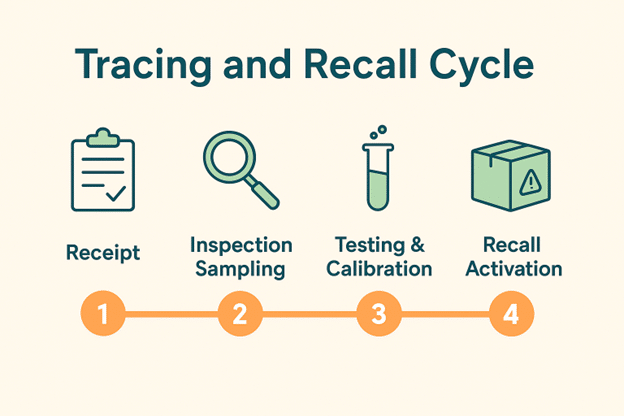
4. They Make Traceability Fast
Ask a food company how long it takes to complete a traceability exercise and you will learn a lot about their system.
Average plants: 4 hours, 6 hours, sometimes more.
Top-performing plants: 30 minutes, 15 minutes, sometimes less.
Why the difference?
Because top plants do not “build” traceability when they need it.
They already have it.
They often use Food traceability software or integrated digital systems that connect:
-
receiving
-
production
-
packaging
-
shipping
So when a lot number is entered, the system already knows:
-
which raw materials were used
-
which batches were produced
-
which finished goods were shipped
-
which customers received them
Traceability becomes a search, not an investigation.
And during a recall, time is everything.
5. They Detect Problems Early
Average plants discover problems during:
-
record review
-
internal audits
-
external audits
-
customer complaints
Top-performing plants discover problems while they are happening.
This is a huge difference.
For example:
Average plant:
-
CCP missed at 10:00
-
QA reviews record at 3:00 p.m.
-
Product already shipped
Top-performing plant:
-
CCP missed at 10:00
-
Alert sent at 10:05
-
Supervisor investigates at 10:10
-
Product placed on hold immediately
One plant reacts late.
The other reacts immediately.
This is why real-time monitoring is becoming standard in modern Food safety systems.
6. They Close Corrective Actions
Many plants are very good at opening corrective actions.
Top-performing plants are very good at closing them.
And more importantly, they make sure corrective actions actually solve the problem.
They don’t just write:
“Operator retrained.”
They ask:
-
Why did the operator make the mistake?
-
Was the procedure unclear?
-
Was the workload too high?
-
Was the form confusing?
-
Was the equipment difficult to use?
-
Was the monitoring frequency unrealistic?
Top-performing plants fix systems, not just people.
7. They Make Food Safety Visible to Management
In many companies, food safety information stays in the QA department.
Top-performing plants make food safety visible to:
-
plant managers
-
operations managers
-
executives
They use dashboards and reports to show:
-
deviation trends
-
audit scores
-
traceability performance
-
environmental monitoring trends
-
supplier issues
-
customer complaints
-
food safety KPIs
This changes the conversation.
Food safety becomes a business performance indicator, not just a QA responsibility.
8. They Prepare for Recalls Before They Happen
Top-performing plants run:
-
mock recalls
-
traceability exercises
-
crisis simulations
They ask questions like:
-
Can we identify all affected lots in 2 hours?
-
Can we identify all customers in 1 hour?
-
Can we contact customers quickly?
-
Can we generate a product list immediately?
They don’t assume they are ready.
They test if they are ready.
9. They Standardize Across Lines and Plants
Struggling plants often have:
-
different forms on each line
-
different procedures on each shift
-
different methods in each plant
-
different traceability formats
Top-performing companies standardize:
-
monitoring forms
-
procedures
-
traceability methods
-
KPIs
-
corrective action processes
Standardization reduces confusion and improves consistency.
10. They Use Data to Improve, Not Just to Prove
This may be the biggest difference of all.
Average plants use records to prove compliance.
Top-performing plants use data to improve performance.
They analyze:
-
Which CCP has the most deviations?
-
Which supplier causes the most issues?
-
Which shift misses the most checks?
-
Which product has the most complaints?
-
Which line has the most environmental positives?
This is how they continuously improve.
The Big Difference: Proactive vs Reactive
When you look at all these differences together, they come down to one thing:
| Average Plants | Top-Performing Plants |
|---|---|
| Reactive | Proactive |
| Paper-based | Data-driven |
| Documentation-focused | Execution-focused |
| Problems found late | Problems found early |
| Traceability takes hours | Traceability takes minutes |
| QA manages food safety | The whole plant manages food safety |
| Corrective actions written | Corrective actions solved |
| Audit preparation stressful | Audit preparation routine |
Top-performing plants are not lucky.
They are designed to perform well.
The Bottom Line
The best food plants understand something very important:
Food safety is not about having the best SOPs.
It is not about having the biggest binders.
It is not about passing audits.
It is about controlling risk every single day during production.
And the companies that do this best usually have:
-
strong execution
-
real-time visibility
-
fast traceability
-
clear accountability
-
meaningful KPIs
-
digital systems that support operations
That is what top-performing food plants do differently.
Final Thought
If you want to evaluate your food safety system, ask these five questions:
-
Do we detect deviations immediately or later?
-
How long does traceability take?
-
Do we track food safety KPIs?
-
Are corrective actions actually preventing recurrence?
-
Can management see food safety performance in real time?
If the answer to most of these questions is “no,” then the opportunity for improvement is huge.
Because the gap between an average plant and a top-performing plant is not paperwork.
It is control, visibility, and execution.