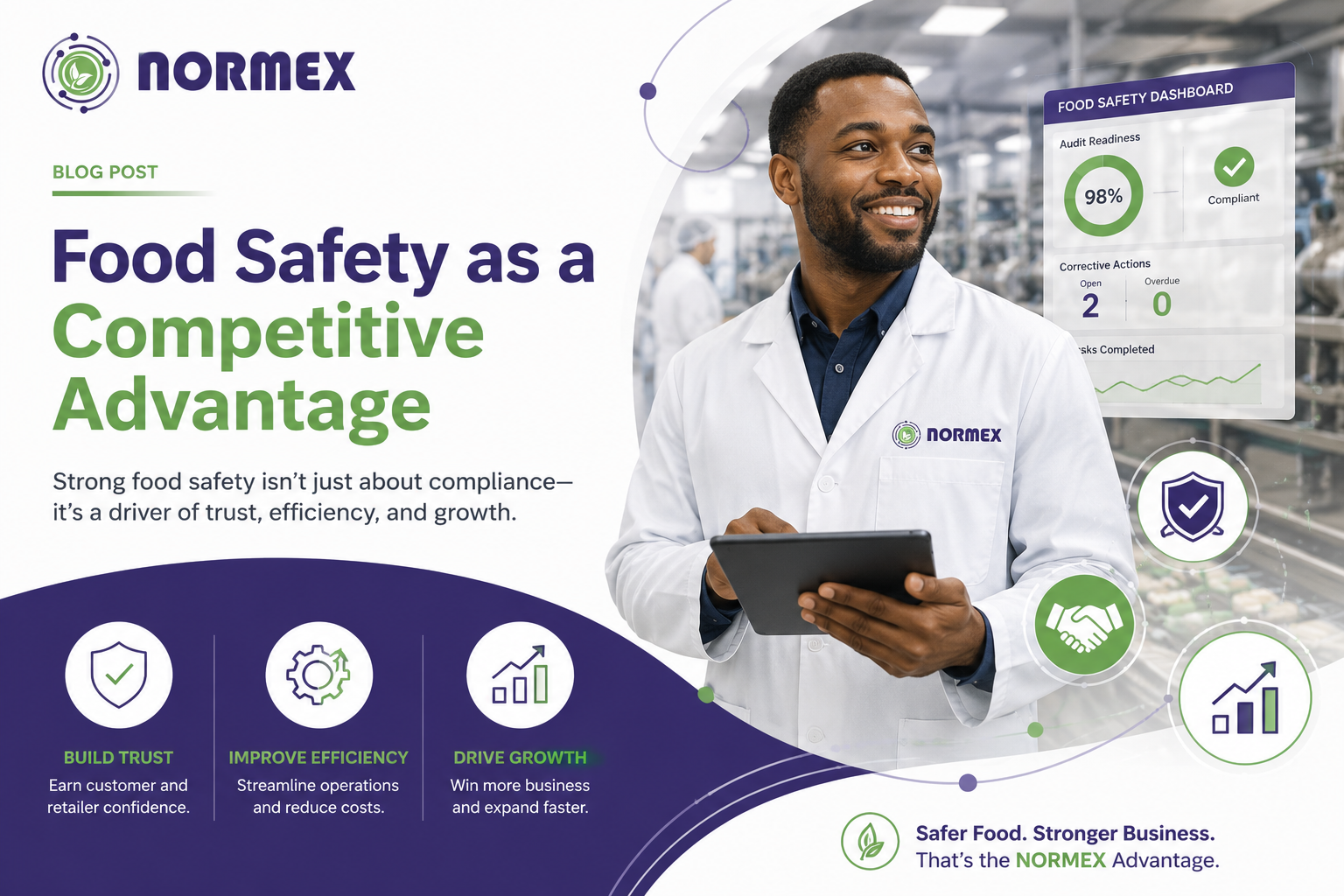
Food Safety as a Competitive Advantage
For many years, food safety was viewed as a cost of doing business.
It was something companies had to do.
A regulatory requirement.
An audit obligation.
A customer expectation.
A necessary expense.
The objective was simple:
Stay compliant. Pass the audit. Avoid recalls.
But the food industry has changed.
Today, food safety is no longer just about avoiding problems.
The companies leading the market have discovered something much more powerful:
Food safety can become a competitive advantage.
Not because customers buy food safety.
But because strong food safety systems create something every customer values:
Confidence.
Confidence that products are safe.
Confidence that suppliers are reliable.
Confidence that deliveries won't be interrupted.
Confidence that recalls will be contained quickly.
Confidence that partnerships will last.
In today's marketplace, confidence is one of the most valuable products a food company can sell.
The Companies Winning Today Think Differently
Many organizations still ask:
"How much does food safety cost us?"
Top-performing companies ask:
"How much business does food safety help us win?"
That single change in perspective transforms everything.
Instead of treating food safety as overhead, they begin seeing it as:
-
a sales advantage,
-
a customer retention strategy,
-
a risk management system,
-
an operational excellence program.
And increasingly, customers are rewarding companies that think this way.
Why Customers Care More Than Ever
Food manufacturers are operating in an environment where trust has become fragile.
Retailers, distributors, and food service companies face enormous pressure.
One supplier failure can lead to:
-
recalls,
-
lost shelf space,
-
legal exposure,
-
damaged brands,
-
lost consumer confidence.
Because of that, customers are asking tougher questions.
Not just:
"Are you certified?"
But:
-
How quickly can you perform a traceability exercise?
-
How do you manage allergens?
-
How do you verify preventive controls?
-
How do you investigate deviations?
-
How do you ensure continuous compliance?
Food safety has become part of supplier selection.
Companies with stronger systems often become preferred suppliers.
Compliance Is No Longer Enough
There was a time when certification alone differentiated companies.
Today, certifications like SQF, BRCGS, FSSC 22000, or HACCP are often expected.
They are the starting point.
Not the finish line.
Customers increasingly evaluate:
-
operational maturity,
-
response speed,
-
transparency,
-
traceability capability,
-
consistency.
Passing audits demonstrates compliance.
Running a highly controlled operation demonstrates excellence.
The difference matters.
The Business Value of Strong Food Safety
1. Winning New Customers
Large retailers and manufacturers carefully evaluate supplier risk.
A supplier with:
-
strong traceability,
-
documented preventive controls,
-
mature corrective action systems,
-
digital visibility,
reduces risk for the customer.
That makes supplier approval easier.
Food safety becomes part of the sales process.
2. Building Customer Trust
Trust isn't built through marketing.
It's built through consistency.
Customers remember suppliers who:
-
respond quickly,
-
investigate thoroughly,
-
communicate transparently,
-
solve problems effectively.
Strong food safety systems strengthen every customer interaction.
3. Faster Response During Incidents
No company wants a recall.
But when incidents occur, response speed matters enormously.
Organizations using integrated Food traceability software can often:
-
identify affected lots,
-
isolate product,
-
notify customers,
-
limit recall scope,
far faster than companies relying on manual systems.
Customers notice that.
And so do regulators.
4. Lower Operating Costs
Many leaders assume food safety always increases costs.
The opposite is often true.
Strong systems reduce:
-
rework,
-
waste,
-
investigation time,
-
downtime,
-
audit preparation,
-
paperwork,
-
recurring deviations.
This is why many organizations invest in food safety software.
Not simply to digitize.
But to improve operational efficiency.
5. Easier Growth
Growth magnifies operational weaknesses.
Companies with mature food safety systems scale more effectively because they already have:
-
standardized processes,
-
digital traceability,
-
structured workflows,
-
performance visibility.
Growth becomes manageable instead of chaotic.
The Hidden Competitive Advantage: Speed
One characteristic consistently separates top-performing food companies.
Speed.
Not production speed.
Decision speed.
They can:
-
answer customer requests quickly,
-
retrieve records instantly,
-
perform traceability in minutes,
-
investigate deviations immediately,
-
prepare for audits effortlessly.
That speed creates confidence.
Confidence creates stronger relationships.
What Top Companies Do Differently
They Invest Before Problems Appear
Average companies improve systems after incidents.
Leading companies improve systems before incidents happen.
They treat food safety as preventive infrastructure.
They Build Visibility
Leadership always knows:
-
current operational status,
-
open deviations,
-
corrective actions,
-
training compliance,
-
traceability readiness.
Real-time visibility allows proactive management.
They Standardize Everything
Consistency becomes easier when:
-
workflows,
-
monitoring,
-
documentation,
-
corrective actions,
follow standardized processes.
Standardization reduces variability.
Reduced variability improves customer confidence.
They Use Data to Improve
Instead of asking:
"Did we pass the audit?"
They ask:
-
Which process generates the most deviations?
-
Which supplier creates recurring issues?
-
Which shift struggles most?
-
Which controls require improvement?
Data drives decisions.
Not assumptions.
They Integrate Operations and Food Safety
Food safety is not isolated inside QA.
Operations owns execution.
Leadership owns accountability.
Everyone owns outcomes.
This creates a stronger organizational culture.
A Real-World Scenario
Imagine two companies competing for the same national retailer.
Both produce similar products.
Both have competitive pricing.
Both are certified.
The retailer asks:
"How quickly can you complete a traceability exercise?"
Company A:
"We'll need several hours to gather all the records."
Company B:
"We can provide complete one-step-back and one-step-forward traceability in less than 15 minutes."
Who appears lower risk?
Who inspires more confidence?
Who is more likely to become the long-term supplier?
The difference wasn't product quality.
It was operational capability.
Step-by-Step: Turning Food Safety Into a Competitive Advantage
Step 1 — Shift the Mindset
Stop viewing food safety as compliance.
Start viewing it as operational excellence.
Step 2 — Invest in Visibility
Know what's happening today—not tomorrow.
Dashboards should show:
-
deviations,
-
monitoring status,
-
corrective actions,
-
food safety KPIs,
-
traceability readiness.
Step 3 — Strengthen Traceability
Fast traceability builds customer confidence.
Integrated Food traceability software allows organizations to respond rapidly during customer requests or recalls.
Step 4 — Automate High-Risk Processes
Automate:
-
monitoring,
-
corrective actions,
-
training management,
-
sanitation verification,
-
document control.
Automation improves consistency.
Step 5 — Measure Operational Performance
Track leading indicators such as:
-
on-time control completion,
-
repeat deviations,
-
CAPA closure time,
-
traceability response,
-
sanitation effectiveness.
These metrics predict future performance.
Step 6 — Involve Leadership
Food safety should appear in executive discussions alongside:
-
production,
-
profitability,
-
customer satisfaction,
-
operational efficiency.
Because food safety influences all of them.
Step 7 — Promote Your Capability
Many companies quietly have excellent food safety systems.
They simply never communicate them.
Customers appreciate suppliers who demonstrate:
-
transparency,
-
preparedness,
-
operational maturity,
-
continuous improvement.
Food safety becomes part of your value proposition.
The Executive Perspective
For executives, the conversation should no longer be:
"How do we reduce food safety costs?"
Instead ask:
"How can food safety strengthen our business?"
Because strong food safety helps:
-
win customers,
-
retain customers,
-
reduce operational risk,
-
improve efficiency,
-
support growth,
-
protect brand value.
Few investments influence so many areas simultaneously.
The Bottom Line
Food safety is no longer simply a regulatory obligation.
It is becoming one of the strongest competitive differentiators in the food industry.
Companies that continue treating it as paperwork will struggle to keep pace.
Companies that treat it as operational excellence will build stronger businesses.
Because customers don't just buy products.
They buy confidence.
And confidence is earned through consistent food safety performance.
Final Thought
Ask yourself one question:
If two companies offered the exact same product at the exact same price, why should a customer choose yours?
Increasingly, the answer is:
Because they trust your food safety system.
That trust may become your most valuable competitive advantage.
See How Digital Food Safety Creates Competitive Advantage
If you'd like to see how modern Food safety systems can strengthen traceability, improve operational visibility, automate compliance, and help differentiate your business, book a live demo here:
Because the strongest companies don't just meet food safety requirements.
They use food safety to outperform the competition.