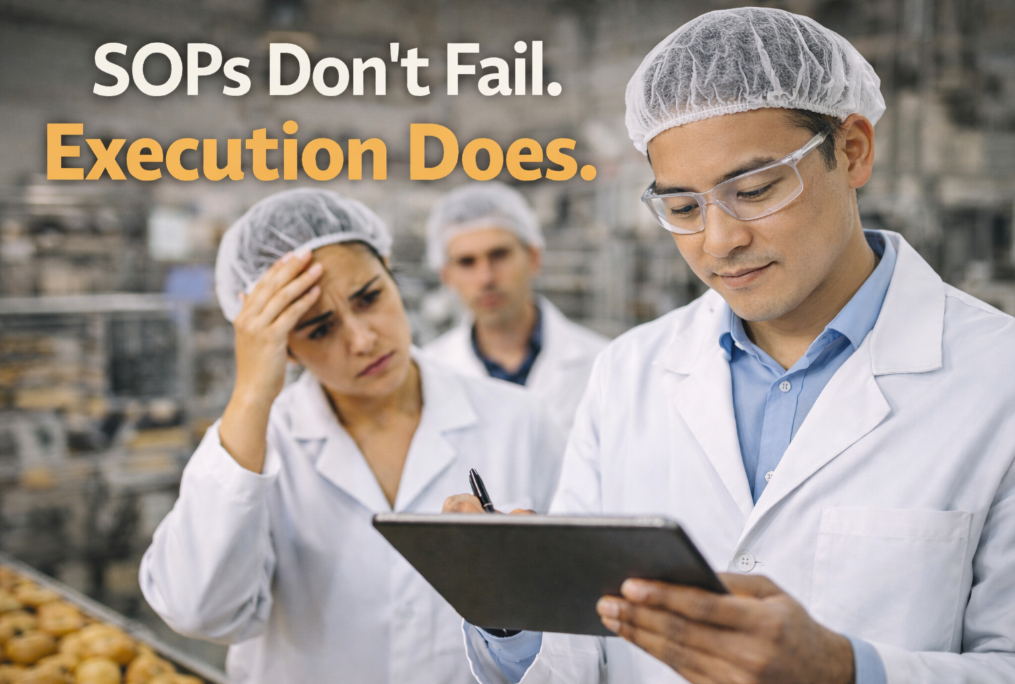
SOPs Don’t Fail. Execution Does.
Walk into almost any food production facility and ask to see their SOPs.
You’ll likely receive a thick binder, a shared drive folder, or a digital system filled with procedures: sanitation procedures, allergen changeover protocols, traceability workflows, corrective action processes, CCP monitoring instructions, and more.
On paper, everything looks solid.
The procedures are documented. The steps are clear. The responsibilities are defined. The records exist.
Yet food safety incidents still happen.
Recalls still occur.
Deviations still repeat.
Auditors still find gaps.
Customers still escalate issues.
So the uncomfortable question becomes:
If SOPs exist, why do failures still occur?
Because in most cases, the problem is not the SOP. The problem is execution.
The Illusion of Control
Food companies often believe that writing procedures equals control.
It doesn’t.
Writing a procedure creates intent.
Execution creates control.
This distinction matters more than most organizations realize.
A sanitation SOP can be perfectly written, but if cleaning is rushed at 2:00 a.m. because production starts early, the SOP becomes irrelevant.
A traceability SOP may clearly describe how to record lot numbers, but if operators abbreviate supplier codes under pressure, traceability breaks.
A metal detector SOP may require hourly verification, but if operators backfill checks later in the shift, the system only looks compliant.
In every one of these situations, the procedure exists — but execution drifted.
And drift is where risk lives.
Why Execution Breaks Down
Understanding why execution fails is the first step to strengthening it.
In food operations, execution problems usually come from five sources.
1. Operational Pressure
Production pressure is real.
Lines must run. Orders must ship. Customers expect delivery.
When production pressure rises, shortcuts appear.
Not because employees are careless—but because the system quietly rewards output more than control.
Examples include:
-
Pre-op inspections completed after startup
-
Label checks rushed during changeovers
-
Allergen cleanings shortened to avoid downtime
-
Monitoring steps backfilled at the end of a shift
Every one of these behaviors starts as a small compromise.
Over time, compromises become normalized routines.
2. SOP Complexity
Many procedures are written for auditors—not operators.
Long documents.
Dense language.
Too many steps.
Too little clarity.
Operators working in fast-paced environments cannot realistically reference a 12-page procedure while a line is moving.
If procedures are not practical, teams simplify them mentally.
And the simplified version becomes the real SOP.
3. Lack of Visibility
Many food safety systems rely heavily on manual documentation.
Paper forms.
Excel sheets.
Standalone logs.
These systems make it difficult to see execution in real time.
When verification happens hours or days later, it becomes impossible to distinguish between:
-
controls completed on time
-
controls completed late
-
controls completed incorrectly
-
controls completed after the fact
This is where many companies turn to food safety software, which can enforce timestamps, required fields, and real-time alerts that make execution visible.
Without visibility, leadership cannot detect drift early.
4. Inconsistent Training
Training often focuses on what to do but not why it matters.
Operators may know that they must check a label, but they may not understand that an incorrect allergen declaration could trigger a nationwide recall.
They may know they must verify a CCP, but they may not understand that missing one check removes the proof that control existed.
Without context, tasks become routine paperwork instead of safety controls.
And routine tasks are the easiest to skip under pressure.
5. Lack of System Reinforcement
Execution improves dramatically when systems make the correct behavior the easiest behavior.
But in many facilities:
-
steps can be skipped
-
records can be backfilled
-
errors can go unnoticed
-
corrective actions can remain open indefinitely
Strong systems reinforce execution through structure.
For example:
-
mandatory monitoring fields
-
timestamped records
-
automatic alerts for missed checks
-
enforced corrective action workflows
These system controls transform procedures from static documents into operational guardrails.
The Cost of Poor Execution
When execution fails, the consequences extend beyond a single deviation.
Weak execution leads to:
Repeat deviations
The same issues appear repeatedly because root causes are never truly addressed.
Audit findings
Auditors detect inconsistent documentation or weak verification.
Traceability gaps
Lot numbers are incomplete, making recalls slower and broader.
Customer trust erosion
Retailers and distributors increasingly demand evidence of control, not just documentation.
Brand risk
A single execution failure can escalate into a product recall or regulatory action.
For executives, this becomes a business risk—not just a quality issue.
Execution Is the Real Food Safety System
In reality, the operational system that protects consumers is not the SOP.
It is the combination of:
-
people
-
processes
-
verification
-
technology
-
accountability
When these elements work together, execution becomes consistent.
When they do not, procedures become theoretical.
The most mature food organizations recognize that Food safety lives in execution, not documentation.
A Step-by-Step Approach to Strengthening Execution
Improving execution does not require rewriting every SOP.
It requires redesigning how procedures are applied in real operations.
Here is a practical approach.
Step 1: Identify Execution-Critical Controls
Not all SOP steps carry equal risk.
Focus first on controls that directly protect food safety.
Examples include:
-
CCP monitoring
-
allergen changeover verification
-
label verification
-
sanitation verification
-
traceability lot capture
-
hold and release procedures
These are the controls where execution failure creates immediate risk.
Step 2: Simplify the Operator Workflow
Procedures must translate into clear operational actions.
Instead of long documents, provide:
-
step-by-step task lists
-
visual aids
-
digital checklists
-
clear acceptance criteria
Example:
Instead of a paragraph describing label verification, provide:
Label Check
-
Confirm product name matches production order
-
Confirm allergen declaration matches formulation
-
Confirm lot code matches batch record
-
Confirm expiry date format
-
Document verification
Clarity reduces interpretation.
Step 3: Make Execution Visible
Visibility is the foundation of accountability.
Leadership should be able to see:
-
which controls were completed
-
when they were completed
-
who completed them
-
whether deviations occurred
Modern food safety software helps by providing real-time dashboards that show execution status across production lines.
Without visibility, organizations rely on trust alone.
And trust without verification creates blind spots.
Step 4: Run Regular Traceability Drills
Traceability is one of the most practical ways to test execution.
Choose a random lot and ask the team to produce:
-
supplier lot information
-
production records
-
CCP monitoring data
-
sanitation verification records
-
shipment destinations
Time how long it takes.
If the process takes hours, execution gaps likely exist.
Many organizations strengthen this area using Food traceability software that links receiving, production, and shipping data.
Step 5: Track Execution KPIs
Execution should be measured, not assumed.
Key metrics include:
-
On-time control completion rate
-
Deviation frequency
-
Repeat deviation rate
-
Corrective action closure time
-
Traceability response time
These indicators reveal whether procedures are being applied consistently.
Step 6: Reinforce Accountability
Execution improves when accountability is clear.
Every critical control should have:
-
a responsible role
-
a verification step
-
a documented response to deviations
Accountability ensures procedures are treated as operational requirements, not administrative tasks.
Real-World Example
Consider a bakery producing thousands of loaves per hour.
Their allergen changeover SOP is well written.
However, during busy shifts, operators occasionally shorten the cleaning process to avoid delaying production.
The SOP exists.
But execution varies.
Eventually, a mislabelled product containing an undeclared allergen reaches the market.
The investigation reveals:
-
the SOP was correct
-
the cleaning verification was inconsistent
-
monitoring records were completed late
The problem was not the procedure.
It was the system that allowed execution to drift.
After implementing digital verification and automated alerts, the bakery improved consistency dramatically.
Execution became visible—and therefore controllable.
The Executive Perspective
From a leadership standpoint, the lesson is clear.
Strong procedures are necessary, but they are not sufficient.
Organizations must build systems that ensure procedures are followed consistently under real operational conditions.
The companies that excel in food safety do not rely on documentation alone.
They invest in:
-
operator-friendly processes
-
real-time monitoring
-
structured workflows
-
digital traceability
-
performance metrics
These elements transform SOPs into operational reality.
The Bottom Line
Procedures do not fail.
Execution does.
Food safety systems break down when:
-
steps are skipped
-
records are backfilled
-
deviations repeat
-
traceability slows
-
accountability fades
But when execution becomes visible, structured, and measurable, procedures regain their power.
And that is where modern food operations are heading.
From static SOP binders to dynamic systems that ensure every step happens exactly when—and how—it should.
See What Strong Execution Looks Like
If you want to see how modern food safety software can help transform SOPs into consistent execution—through real-time monitoring, automated workflows, and integrated traceability—schedule a demo here:
Bring one SOP you know is difficult to enforce consistently.
Because the real goal isn’t to write better procedures.
It’s to make execution unavoidable.