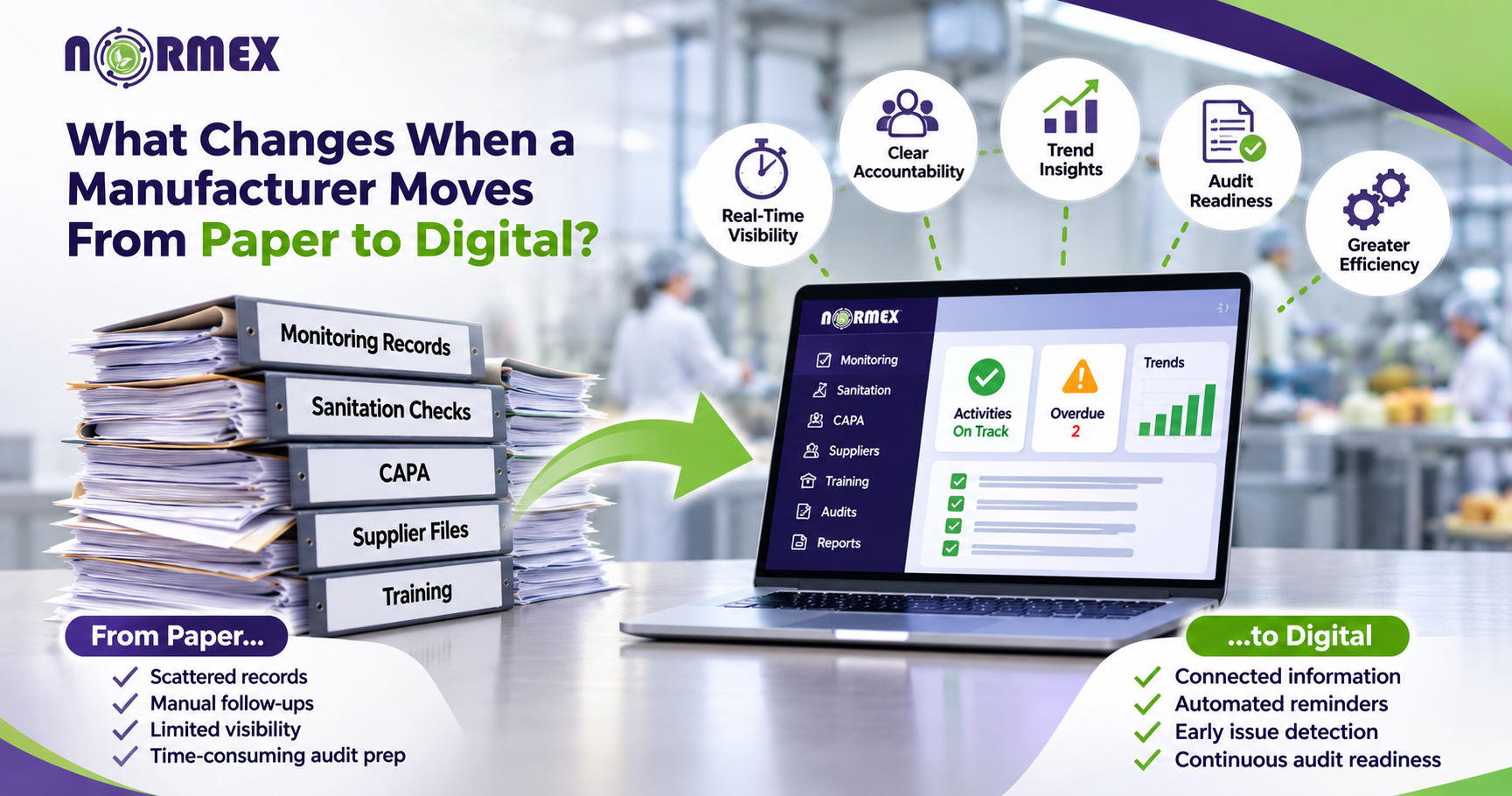
What Changes When a Manufacturer Moves From Paper to Digital?
Imagine running your food manufacturing facility without chasing missing records, reminding employees to complete checks, or spending days preparing for an audit. What would your team accomplish with that time back?
For many food manufacturers, going digital sounds like a technology project.
But the real transformation has very little to do with replacing paper forms with electronic ones.
It's about changing how your organization operates.
When food safety records, corrective actions, supplier approvals, training, and production information become connected, something important happens:
Your team stops spending so much time finding out what happened yesterday and starts focusing on what needs attention today.
In this newsletter, we'll explore six practical changes manufacturers can expect when moving from paper-based food safety management to digital systems—and why the biggest benefit isn't necessarily saving paper.
Food Safety Management | Digital Transformation | Operational Efficiency | 5-minute read
1. From Chasing Records to Knowing What's Happening
It's 8:00 a.m.
Your QA manager arrives at the facility and begins reviewing yesterday's production records.
One temperature monitoring form is missing.
A sanitation inspection hasn't been signed.
A corrective action remains incomplete.
The supervisor responsible is on another shift.
Now the investigation begins.
Was the activity completed but not documented? Was the form misplaced? Or was the check actually missed?
With paper records, discovering the problem can take longer than resolving it.
What changes with digital?
Instead of waiting until forms are collected and reviewed, a digital system can show which activities are completed, pending, or overdue.
Supervisors can see what requires attention.
QA can identify exceptions earlier.
Management can monitor performance without physically collecting documents.
The biggest change is visibility. You no longer have to search for a problem before you can address it.
Of course, digital systems cannot guarantee that every task was performed correctly. Effective verification remains essential.
2. From Manual Reminders to Clear Accountability
Think about how much time your QA team spends reminding people to complete their responsibilities.
Temperature checks.
Sanitation inspections.
Supplier reassessments.
Training renewals.
Preventive maintenance.
Corrective actions.
In a paper-based environment, someone must maintain the schedule, communicate deadlines, and follow up on incomplete activities.
Often, that person is the QA manager.
This creates unnecessary administrative work and makes the organization dependent on individual memory.
What changes with digital?
Recurring tasks can be scheduled automatically.
Responsibilities can be assigned to specific employees.
Reminders can notify the appropriate people.
Overdue activities can be escalated.
Instead of QA personally coordinating every task, the system supports accountability.
Employees still need to perform the work.
Supervisors still need to verify results.
But the process becomes more structured and transparent.
Accountability becomes part of the workflow instead of something someone must constantly chase.
3. From Reacting to Problems to Recognizing Patterns
Imagine a sanitation issue occurring three times in six months.
Each time, the equipment is cleaned again.
A corrective action is documented.
The issue is closed.
But the same problem keeps returning.
In a paper-based system, recognizing the pattern may require manually reviewing months of records.
And unless someone makes that connection, the underlying problem may remain unresolved.
What changes with digital?
When deviations and corrective actions are recorded consistently in a connected system, recurring issues become easier to identify.
Management can examine trends by equipment, department, production line, or type of nonconformity.
Instead of asking, “How do we correct this problem?” every time, the team can ask:
“Why does this problem keep happening, and what must change to prevent it?”
That shift is significant.
Corrective actions become opportunities for operational improvement rather than administrative exercises.
Digital records alone do not perform root cause analysis. But they can provide the information needed to conduct it more effectively.
4. From Audit Preparation to Continuous Audit Readiness
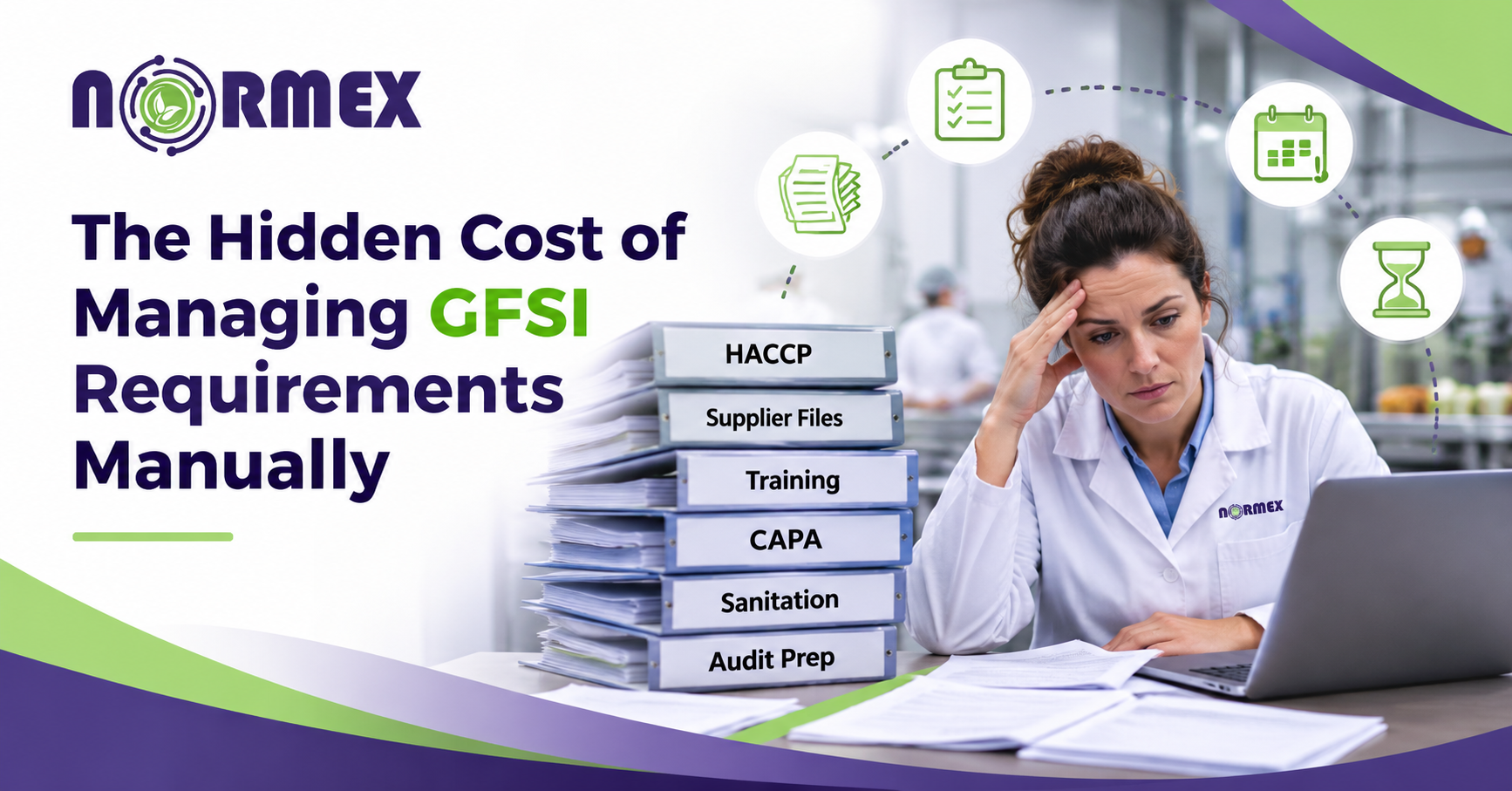
For many manufacturers, preparing for a food safety audit is still a major project.
Weeks before the audit, QA begins collecting records, checking supplier certificates, updating training files, reviewing corrective actions, and confirming that monitoring documentation is complete.
Employees are asked to locate missing information.
Supervisors spend additional time organizing evidence.
Management wants reassurance that everything is ready.
Then the audit ends.
The facility returns to its usual routine.
Until the next audit approaches.
What changes with digital?
Records can be organized as activities are completed.
Document versions can be controlled.
Corrective actions can be tracked from identification through effectiveness verification.
Supplier documents can be monitored for upcoming expiration.
Internal audit findings can be linked to follow-up actions.
This supports ongoing readiness for requirements under GFSI-recognized certification programs such as SQF, BRCGS, and FSSC 22000.
Audit readiness becomes a daily operating discipline—not a seasonal emergency.
A digital system does not automatically make a manufacturer compliant or guarantee certification. The organization must still establish appropriate controls, implement them effectively, and maintain reliable evidence.
5. From Disconnected Departments to One Shared Picture
Food safety doesn't belong exclusively to QA.
Production performs monitoring activities.
Sanitation maintains hygienic conditions.
Maintenance manages equipment reliability.
Purchasing works with suppliers.
Receiving verifies incoming materials.
Shipping controls finished product movements.
Every department contributes to the effectiveness of the food safety system.
But when each department uses different paper forms, spreadsheets, or email threads, important information can become fragmented.
Consider a supplier that repeatedly delivers materials outside specification.
Receiving documents the deviations.
QA investigates.
Purchasing continues placing orders.
Management may not recognize the pattern until the issue becomes serious.
What changes with digital?
A connected food safety management system can make relevant information accessible across departments.
Supplier deviations can inform supplier evaluations.
Maintenance issues can be linked to corrective actions.
Production records can support traceability.
Training requirements can be connected to employee responsibilities.
The objective is not for everyone to see everything. Appropriate access controls still matter.
It is to ensure that the right people have the right information when decisions need to be made.
Food safety becomes a coordinated operational responsibility rather than a collection of disconnected departmental activities.
6. From Administrative Work to Higher-Value Activities
This may be the most important transformation.
Consider a hypothetical manufacturer where QA and operations spend 15 hours each week on manual administrative activities.
These include searching for records, sending reminders, organizing documentation, and preparing reports.
At a fully loaded labour cost of CAD $45 per hour, that represents approximately $35,100 annually in labour capacity.
What if a more efficient system reduced that administrative workload by 40%?
<box border radius="lg" padding={3} gap={3}> <text weight="medium">Illustrative annual administrative workload</text> <grid columns={2} gap={3}> <grid-item> <text color="secondary" size="xs">Paper-based process</text> <title size="xl" color="default" tabularNums>$35,100</title> </grid-item> <grid-item> <text color="secondary" size="xs">After a hypothetical 40% reduction</text> <title size="xl" color="default" tabularNums>$21,060</title> </grid-item> </grid> <box gap={1}> <text color="secondary" size="xs">Potential annual labour capacity recovered</text> <title size="2xl" color="success" tabularNums>312 hours</title> **Equivalent to $14,040 at the assumed labour rate.** </box> <caption>Illustrative scenario only, not a NORMEX customer result or an industry benchmark. Recovered capacity is not necessarily a reduction in payroll expenses.</caption> </box>
That is nearly eight 40-hour working weeks.
Imagine redirecting those hours toward:
-
Improving preventive controls
-
Investigating recurring nonconformities
-
Coaching production employees
-
Strengthening supplier performance
-
Conducting meaningful internal audits
-
Improving processes and reducing waste
The value of digital transformation is not simply that employees complete paperwork faster.
It's that skilled employees can spend more time doing the work that actually improves food safety.
What Digital Transformation Really Changes
| Paper-based management | Digital management |
|---|---|
| Records collected after activities | Records entered and available closer to real time |
| Manual reminders | Scheduled tasks and notifications |
| Missing forms discovered during review | Incomplete activities can be flagged earlier |
| Separate corrective action files | Connected CAPA workflows |
| Supplier documents tracked manually | Centralized documentation and expiration monitoring |
| Audit evidence assembled from multiple sources | Organized, accessible records |
| Trends identified through manual analysis | More efficient reporting and trend analysis |
| QA coordinates much of the administration | Responsibilities shared through defined workflows |
The difference is not just convenience.
It's the ability to manage food safety more consistently across the organization.
The Biggest Mistake: Digitizing Paper Without Improving the Process
There is an important distinction between going paperless and becoming digital.
If you take an inefficient paper form and recreate it exactly on a tablet, you may eliminate printing.
But you haven't necessarily improved the process.
If employees still enter the same information multiple times, if supervisors still rely on emails for follow-ups, and if departments remain disconnected, much of the original inefficiency remains.
Before implementing digital food safety software, manufacturers should ask:
Which activities are unnecessarily complicated today?
Where are we duplicating information?
Which critical tasks depend on someone remembering to follow up?
What information does management need but struggle to access?
Which recurring problems are difficult to identify?
The goal should be to simplify workflows, strengthen accountability, and improve visibility—not merely replace paper with screens.
A phased implementation is often more practical than changing every process at once.
Start with high-frequency activities such as daily monitoring and sanitation, then progressively connect supplier management, corrective actions, traceability, and other processes.
The Executive Perspective: Digital Transformation Is an Operational Decision
For CEOs and plant managers, the business case for digital food safety management goes beyond compliance.
It can affect productivity, operational visibility, risk management, and the organization's ability to scale.
As production grows, the volume of records, employees, suppliers, and monitoring activities typically increases.
In a manual system, that growth can create additional administrative workload.
A well-designed digital system can help the organization manage greater complexity without increasing administrative effort at the same rate.
But technology is not a substitute for leadership.
Successful implementation still requires clear responsibilities, employee training, appropriate procedures, and management commitment.
Executives should evaluate digital transformation through three questions:
1. Efficiency: How much unnecessary administrative work can we reduce?
2. Risk: How much earlier can we identify and respond to critical issues?
3. Scalability: Can our current food safety management approach support the next stage of business growth?
The right technology investment should help address all three.
The Bottom Line
When a food manufacturer moves from paper to digital, the most important changes are not the disappearance of binders or the introduction of tablets.
They are the changes in how the organization operates.
Information becomes easier to access.
Responsibilities become clearer.
Problems can become visible earlier.
Corrective actions become easier to track.
Audit preparation becomes less disruptive.
And food safety professionals can redirect valuable time toward prevention and continuous improvement.
The real transformation happens when food safety moves from documenting what happened to actively managing what happens next.
Final Thought
Tomorrow morning, ask your QA manager one question:
“How much of your day is spent managing food safety—and how much is spent managing paperwork?”
Then imagine what your organization could achieve if that balance changed.
Because the future of food safety isn't about collecting more records.
It's about making better decisions with the information you already collect.
Paper tells you what happened. A well-designed digital system helps you see what needs to happen next.
Ready to Move Beyond Paper? Discover NORMEX.
At NORMEX, we help food manufacturers simplify daily food safety management through connected digital workflows.
From monitoring and sanitation to supplier management, corrective actions, training, internal audits, and traceability, NORMEX helps teams organize critical information and maintain greater operational visibility.
Our approach is practical: start with your daily operations, build consistent habits, and expand progressively as your team becomes comfortable.
Less paperwork. Better visibility. Stronger food safety management.