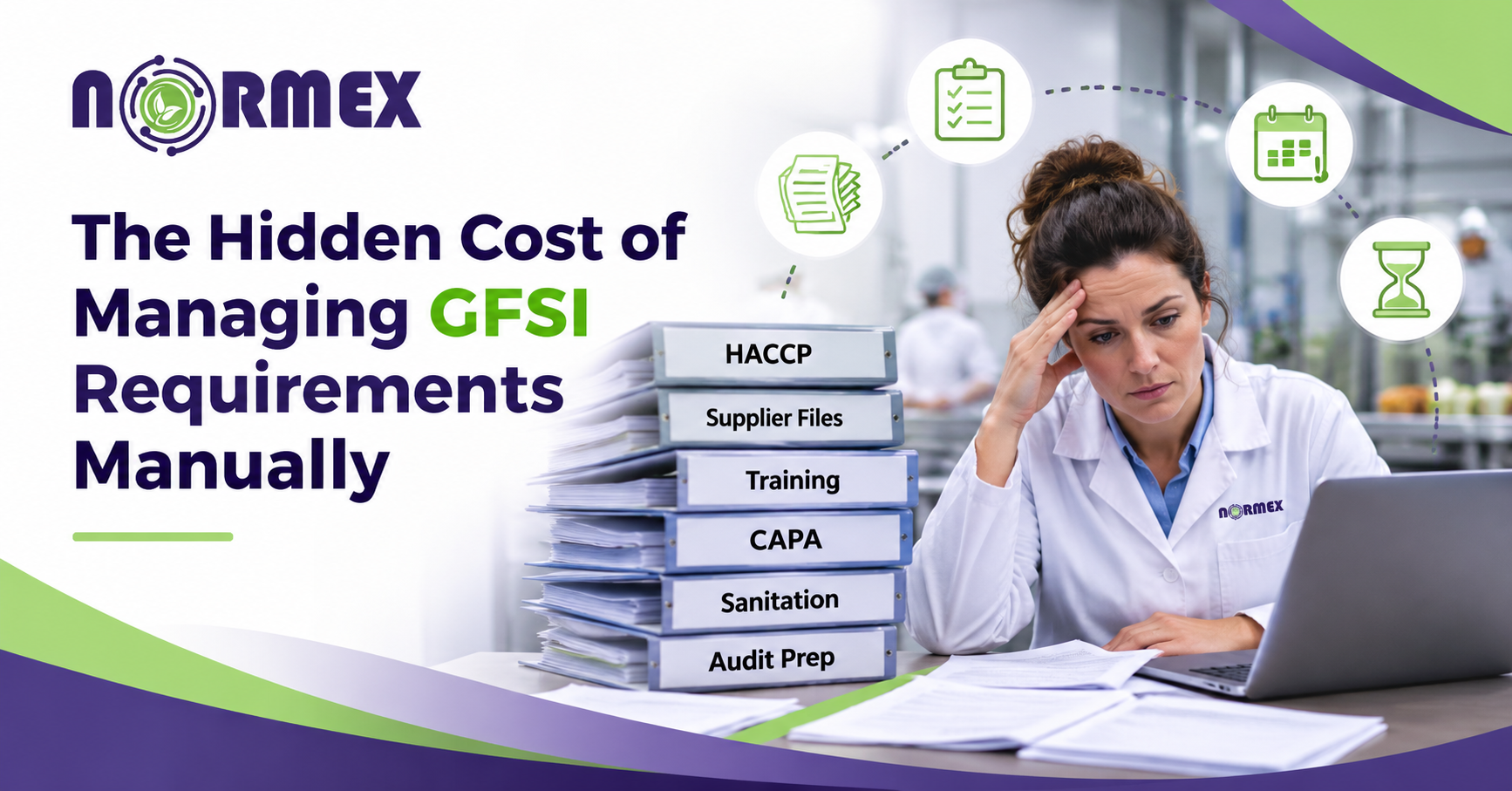
The Hidden Cost of Managing GFSI Requirements Manually
What if your food safety team could reclaim hundreds of hours every year—not by reducing compliance requirements, but by eliminating unnecessary administrative work?
For many food manufacturers, the biggest opportunity to improve food safety isn't another procedure, another checklist, or another employee.
It's giving qualified professionals more time to prevent problems instead of chasing paperwork.
Every week, valuable hours disappear into spreadsheets, emails, missing records, overdue corrective actions, and manual follow-ups.
And the real cost goes beyond labour. Disconnected information can delay critical decisions, hide recurring problems, and turn audit preparation into an exhausting exercise.
In this newsletter, we'll uncover five hidden costs of managing GFSI requirements manually, show you how to calculate their financial impact, and share five practical ways to reduce administrative workload without compromising food safety.
You may discover that the most expensive part of your compliance program isn't certification itself.
It's everything your team does manually to maintain it.
Food Safety Management | GFSI-Aligned Compliance | Operational Efficiency | 5-minute read
1. The Cost of Searching for Information
Imagine your next food safety certification audit is approaching.
The auditor requests evidence that a corrective action from six months ago was implemented and verified for effectiveness.
Your QA manager opens a spreadsheet to locate the original deviation.
The corrective action is documented in another file.
The maintenance work order is stored separately.
The verification evidence is buried in an email.
Twenty minutes later, the information is finally assembled.
The records existed all along.
The problem was finding and connecting them.
Now multiply that situation across supplier approvals, sanitation records, temperature monitoring, training, internal audits, preventive maintenance, and traceability.
For manufacturers working toward or maintaining certification under GFSI-recognized programs such as SQF, BRCGS, or FSSC 22000, the administrative burden can become substantial.
Having the right records is essential. Spending excessive time searching for them is not.
The hidden cost is the time your team loses every time information must be reconstructed.
2. The Cost of Manual Follow-Ups
In many food manufacturing facilities, QA managers have become human reminder systems.
They follow up with supervisors about incomplete checks.
They contact suppliers about expiring certificates.
They remind employees about training renewals.
They chase maintenance teams for outstanding work orders.
They verify whether corrective actions were completed.
These activities are necessary.
But should a highly trained food safety professional spend hours every week reminding people to do what the system should already be tracking?
Consider a critical monitoring task scheduled for 10:00 a.m.
The employee becomes distracted by a production issue.
The task is missed.
Nobody notices until QA reviews the records at the end of the shift.
Depending on the control, the organization may now need to investigate potentially affected product.
The problem isn't simply that someone forgot.
The system failed to make the missed activity visible when intervention was still possible.
A stronger approach uses clear task ownership, scheduled reminders, overdue notifications, and appropriate escalation.
That allows QA professionals to focus on exceptions and risk rather than manually checking whether everyone completed their assignments.
3. The Cost of Discovering Problems Too Late
In food safety, timing matters.
A sanitation deviation discovered before production starts may require additional cleaning and verification.
The same deviation discovered after several hours of production may require a much broader investigation.
A supplier documentation issue identified before purchasing can be resolved through the approval process.
Discovered after materials have been received or used, it may create additional uncertainty.
An overdue corrective action identified immediately can be escalated.
Discovered months later, the underlying problem may have continued.
Manual systems often create a delay between when a problem occurs and when management becomes aware of it.
This is particularly concerning when monitoring records are reviewed retrospectively.
The longer a significant problem remains invisible, the more difficult and costly it may become to resolve.
Digital food safety management can help shorten that delay through real-time task status, notifications, and exception reporting.
Technology cannot guarantee that problems will never occur.
But it can help organizations recognize them sooner.
4. The Cost of Repeating the Same Problems
Consider a facility experiencing recurring sanitation failures.
In January, a piece of equipment fails its pre-operational inspection.
The equipment is cleaned again.
A corrective action is documented.
The issue is closed.
In March, the same problem occurs.
Another corrective action.
Another cleaning.
Another closed record.
In May, it happens again.
Why wasn't the pattern identified earlier?
Perhaps each incident was recorded in a different spreadsheet.
Perhaps management reviewed corrective actions individually rather than analyzing trends.
Perhaps the original investigation focused on retraining employees without addressing equipment design or cleaning procedures.
Whatever the reason, the organization has spent additional time and resources responding to a problem it had already encountered.
Repeated deviations can create:
-
Additional labour and investigation time
-
Production delays
-
Increased product holds or waste
-
Maintenance expenses
-
Audit findings
-
Greater operational risk
A connected corrective and preventive action (CAPA) process makes it easier to identify recurring problems, track ownership, monitor deadlines, and verify effectiveness.
The objective is not to close corrective actions faster. It is to stop solving the same problem repeatedly.
5. The Cost of Preparing for Audits
A food safety certification audit should evaluate how effectively your management system operates.
It should not require weeks of emergency document collection.
Yet many manufacturers experience the same cycle.
A few weeks before the audit, QA begins organizing records, updating supplier files, reviewing training documentation, following up on overdue corrective actions, and preparing evidence.
Other departments are asked to locate missing information.
Employees work additional hours.
Management becomes increasingly focused on audit readiness.
Then the audit ends.
Everyone returns to normal operations.
Until the next audit approaches.
This creates a recurring administrative burden that rarely appears as a separate line in the company's financial statements.
But the cost is real.
Audit readiness should be the result of consistent daily execution—not a separate project that begins when the auditor is coming.
What Is Manual Compliance Actually Costing Your Business?
Let's put some numbers behind the problem.
Consider a hypothetical mid-sized food manufacturer managing its food safety program primarily through spreadsheets, paper forms, shared folders, and emails.
Its weekly administrative workload might look like this:
| Manual activity | Hours per week |
|---|---|
| Searching for and organizing records | 5 |
| Following up on overdue activities | 4 |
| Managing supplier documentation | 3 |
| Tracking corrective actions | 3 |
| Preparing compliance reports | 3 |
| Total | 18 hours |
Assume a fully loaded labour cost of CAD $45 per hour.
<box border radius="lg" padding={3} gap={2}> <grid columns={2} gap={3}> <grid-item> <text color="secondary" weight="medium" size="xs">Weekly administrative cost</text> <title size="xl" color="default" tabularNums>$810</title> </grid-item> <grid-item> <text color="secondary" weight="medium" size="xs">Annual administrative cost</text> <title size="xl" color="default" tabularNums>$42,120</title> </grid-item> </grid> <divider color="subtle"/> <text color="secondary" size="xs">Illustrative scenario based on 18 hours per week × $45/hour × 52 weeks. These are not industry benchmarks or verified NORMEX customer savings.</text> </box>
That is more than $42,000 annually in labour capacity associated with these manual activities alone.
It excludes the potential cost of overtime, production interruptions, repeated investigations, rejected materials, and product holds.
Now imagine reducing that administrative workload by 40%.
<box border radius="lg" padding={3} gap={2}> <text color="secondary" weight="medium" size="xs">Potential annual capacity recovered</text> <title size="2xl" color="default" tabularNums>374 hours</title> <text color="secondary">Approximately **$16,848** in annual labour capacity, at the assumed rate.</text> </box>
That does not necessarily translate into an equivalent reduction in payroll expenses. It represents time that could potentially be redirected toward preventive activities, employee development, supplier improvement, and stronger operational controls.
The question is not whether digitalization eliminates the cost of compliance.
It's whether your organization is spending more time than necessary managing it.
Five Practical Ways to Reduce the Burden
1. Centralize Your Food Safety Information
Stop managing critical information across disconnected locations.
Bring relevant sanitation records, monitoring activities, supplier documents, training, internal audits, and corrective actions into an organized environment.
Employees should know where to find current records without searching through multiple folders and applications.
2. Automate Recurring Tasks and Reminders
Identify activities that require regular follow-up.
These may include supplier reassessments, training renewals, preventive maintenance, internal audits, and corrective action deadlines.
Assign clear responsibilities and use automated reminders or notifications where appropriate.
The objective is to reduce dependence on individual memory.
3. Connect Deviations to Corrective Actions
When a problem occurs, its investigation, assigned actions, deadlines, implementation evidence, and effectiveness verification should be traceable.
This makes it easier to identify unresolved issues and recognize recurring failures.
4. Make Compliance Performance Visible
Management should be able to identify:
-
Overdue critical tasks
-
Open and overdue corrective actions
-
Recurring nonconformities
-
Supplier performance concerns
-
Outstanding verification activities
The objective is to focus attention on issues requiring intervention instead of manually reviewing every record to discover exceptions.
5. Measure the Time Your Team Spends on Administration
Before investing in any new technology, establish your baseline.
For two weeks, ask your QA and operations teams to record the time spent searching for records, sending reminders, reconciling information, and preparing reports.
Then identify which activities create the greatest burden.
Prioritize improvements based on both potential time savings and food safety risk.
You cannot demonstrate the value of an improvement if you never measure the problem it is intended to solve.
The Executive Perspective: Compliance Is Not Just a QA Expense
Food safety compliance is often treated as the responsibility of the QA department.
But inefficient compliance processes affect the entire business.
Production supervisors lose time searching for records.
Purchasing teams follow up on supplier documentation.
Maintenance personnel respond to recurring issues.
Management waits for information before making decisions.
And skilled QA professionals spend valuable hours coordinating administrative work.
For executives, the question should not simply be:
“Are we meeting our food safety requirements?”
It should also be:
“Are we managing those requirements in the most effective and efficient way?”
A well-designed food safety management system should make compliance easier to execute, easier to verify, and easier to improve.
This does not mean reducing controls or replacing professional judgment with software.
It means eliminating unnecessary friction so employees can focus on the work that actually protects food safety.
The Bottom Line
GFSI-recognized certification programs require discipline, documentation, monitoring, verification, and continuous improvement.
Those requirements are essential.
But managing them through disconnected spreadsheets, paper records, emails, and manual reminders creates avoidable complexity.
The hidden cost is not limited to audit preparation.
It includes the administrative workload accumulated every day, the delayed detection of problems, repeated corrective actions, and missed opportunities for prevention.
The goal of digital food safety management is not to make compliance less rigorous. It is to make rigorous compliance easier to execute consistently.
Final Thought
Here is a question worth asking at your next management meeting:
If your certification audit were tomorrow, how many hours would your team need just to gather the evidence?
Then ask a second question:
What could those same employees accomplish if they spent half that time preventing food safety problems instead?
The answers may reveal a significant opportunity.
Because the real cost of manual compliance isn't simply the money spent managing records.
It's the improvement your team could have delivered if it weren't so busy chasing them.
Simplify GFSI-Aligned Compliance With NORMEX
At NORMEX, our mission is to help food manufacturers—especially small and medium-sized businesses—manage food safety more effectively through digital transformation.
NORMEX brings food safety activities, supplier management, corrective actions, internal audits, training, document control, and traceability into a connected digital environment.
The objective is straightforward: reduce unnecessary administrative work, improve operational visibility, and help teams maintain audit readiness throughout the year.
Less time chasing records. More time protecting food safety.