Can Digital Food Safety Improve More Than Compliance?
What if your food safety system could do more than help you pass audits? What if it could also reduce operational costs, improve productivity, prevent recurring problems, and help your business grow?
For many food manufacturers, food safety is still viewed primarily as a compliance obligation.
Something the company must maintain to satisfy regulatory requirements, meet customer expectations, or achieve certification under GFSI-recognized programs such as SQF, BRCGS, or FSSC 22000.
But this perspective overlooks a significant opportunity.
Every day, your food safety program generates valuable operational information.
Temperature records. Sanitation inspections. Supplier evaluations. Corrective actions. Production records. Equipment checks. Training activities. Traceability information.
Most manufacturers already collect this data.
The challenge is that much of it remains buried in paper binders, spreadsheets, and disconnected systems.
What if that information could help you make better business decisions instead of simply demonstrating compliance?
In this newsletter, we'll explore six ways digital food safety management can create value beyond compliance—and why the greatest return on investment may come from improvements across your entire operation.
Food Safety Management | Digital Transformation | Operational Efficiency | 6-minute read
1. From Compliance Costs to Operational Efficiency
Let's start with a familiar situation.
It's Monday morning.
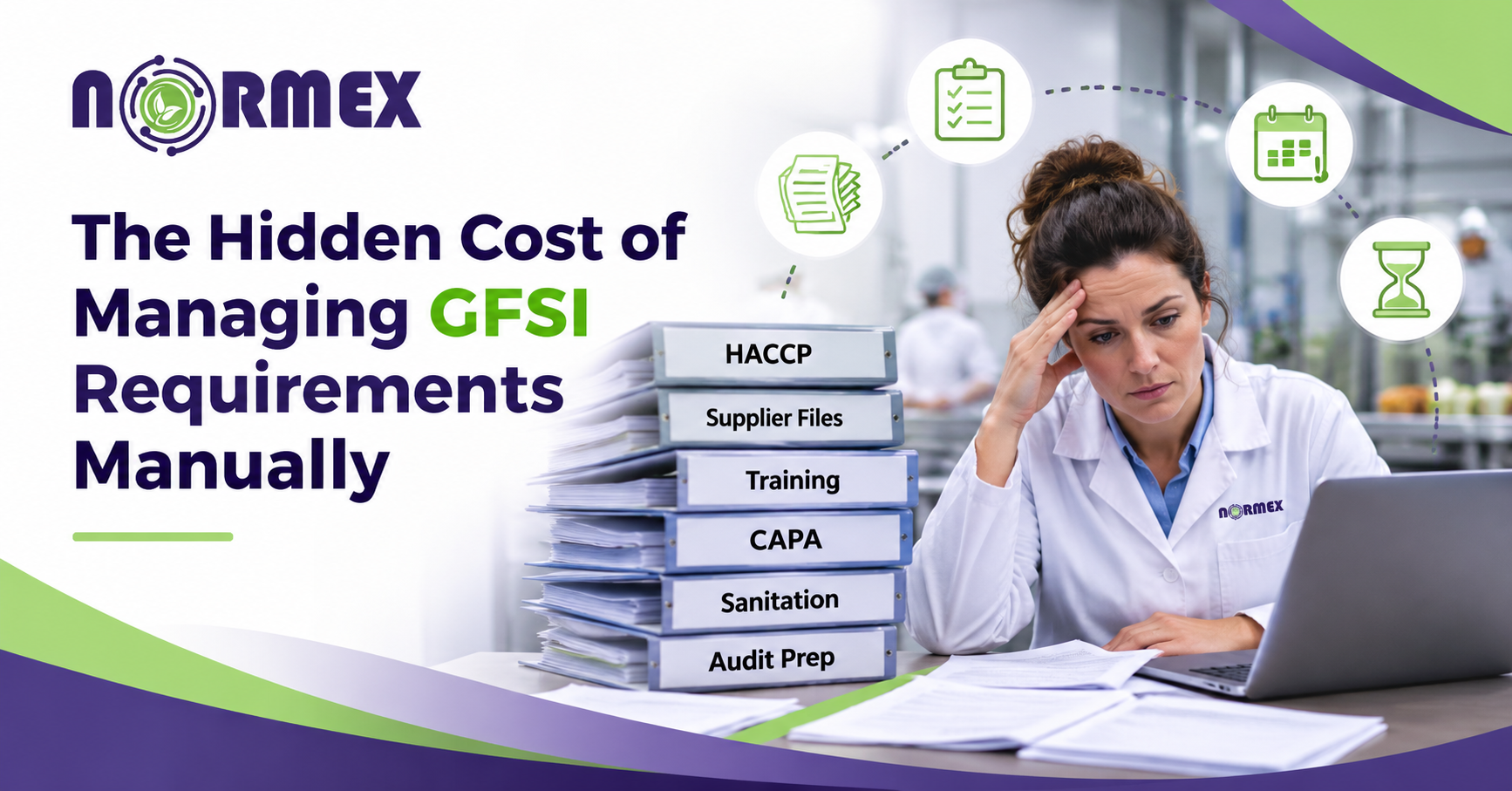
Your QA manager is reviewing production records from the previous week.
Several temperature monitoring forms are missing.
A sanitation checklist hasn't been signed.
Two corrective actions remain open.
A supplier certificate has expired.
The next two hours are spent locating records, contacting employees, and confirming whether activities were completed.
Nothing has necessarily gone wrong with the food.
But valuable time has been lost managing information.
Now imagine a different situation.
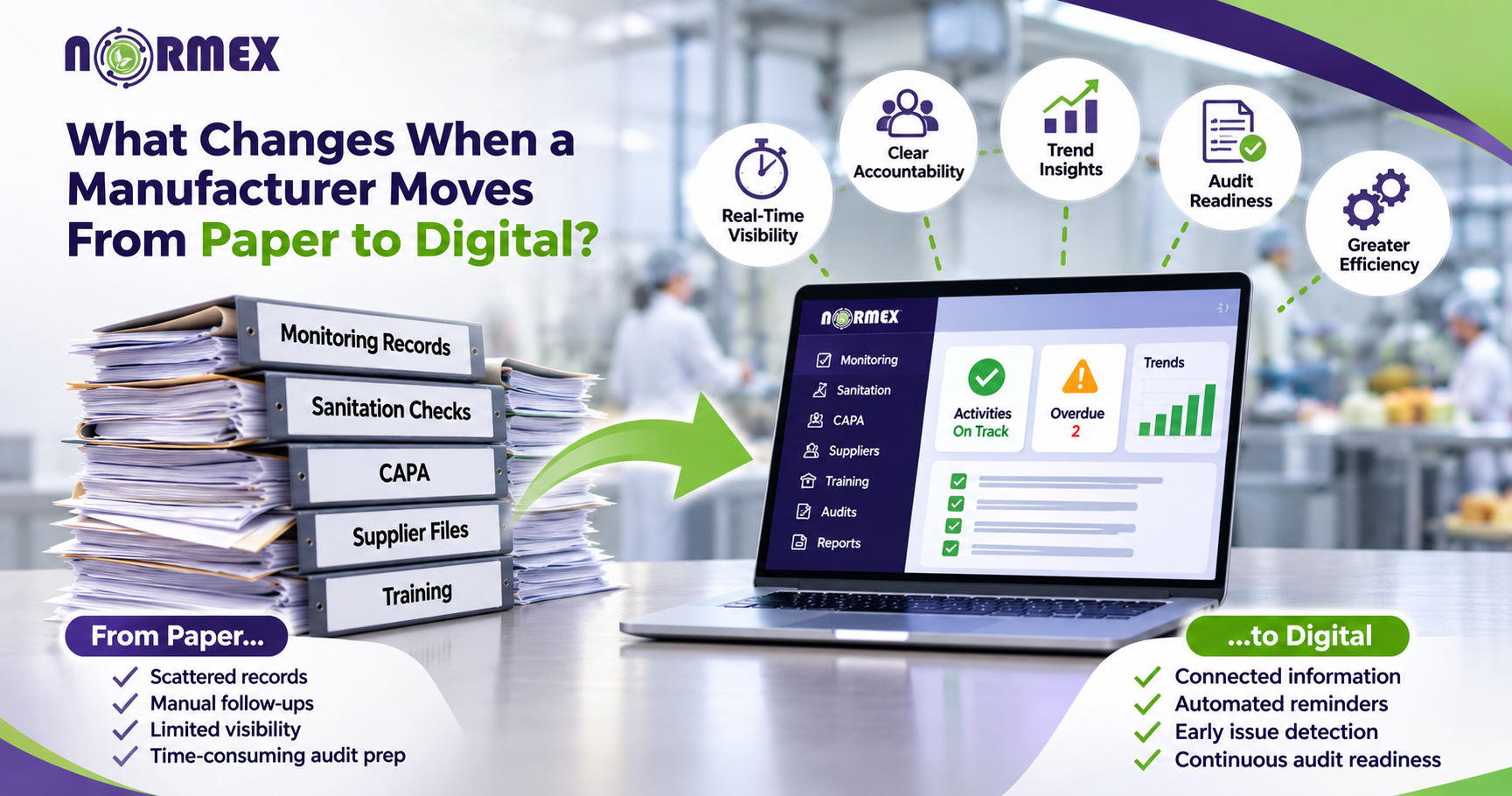
The QA manager opens a digital dashboard.
Completed activities are visible.
Overdue tasks are identified.
Outstanding corrective actions have assigned owners.
Supplier documentation requiring attention is flagged.
Instead of spending the morning discovering what needs attention, the team can begin addressing it.
The business benefit
Digital food safety management can reduce time spent on routine administrative coordination, including:
-
Collecting and organizing records
-
Following up on incomplete activities
-
Searching for documentation
-
Preparing compliance reports
-
Tracking corrective action deadlines
The objective isn't to eliminate verification or reduce oversight.
It's to remove unnecessary administrative work.
When skilled employees spend less time managing paperwork, they have more time to improve operations.
2. From Repeated Problems to Lower Operating Costs
Consider a food manufacturer experiencing recurring sanitation failures.
Every few weeks, a piece of equipment fails its pre-operational inspection.
Production is delayed.
The sanitation team cleans the equipment again.
QA performs another verification.
A corrective action is documented.
Eventually, production begins.
The immediate issue is resolved.
But the problem keeps returning.
In a paper-based system, identifying the pattern may require reviewing several months of records.
And unless someone connects those records, the underlying cause may remain unresolved.
Perhaps the equipment has a design problem.
Perhaps the cleaning procedure is inadequate.
Perhaps the sanitation schedule doesn't provide enough time.
What changes with digital?
When sanitation results, nonconformities, corrective actions, and equipment information are connected, recurring problems become easier to recognize.
Management can examine trends by equipment, production line, shift, or type of deviation.
This supports more effective root cause investigations and preventive improvements.
The potential financial benefits extend beyond compliance:
-
Less repeated cleaning
-
Fewer avoidable production delays
-
Reduced rework and product waste
-
Better use of maintenance resources
-
Less time spent investigating recurring incidents
A digital system doesn't automatically solve these problems.
But it can make the evidence needed to solve them more accessible.
The real value comes when food safety information helps eliminate operational problems—not simply document them.
3. From Reactive Maintenance to Better Equipment Reliability
Equipment reliability is often treated primarily as a maintenance responsibility.
But equipment condition can directly affect food safety.
Damaged gaskets, worn conveyor belts, cracked utensils, poorly maintained drains, and malfunctioning temperature controls may introduce contamination or process-control risks.
Consider a recurring equipment defect identified during sanitation inspections.
The issue is documented on paper.
Maintenance receives a verbal notification.
The repair is postponed because production is busy.
A few weeks later, the same defect is reported again.
The information exists.
But there is no reliable connection between the inspection finding, the maintenance request, and the verification that the problem was resolved.
What changes with digital?
A connected workflow can help link equipment-related deviations with maintenance actions, assigned responsibilities, and completion evidence.
Management can identify repeated equipment problems and monitor overdue work.
This can support better preventive maintenance planning and help reduce avoidable interruptions.
Food safety records can become an early warning system for equipment reliability.
That creates value for QA, maintenance, production, and management.
4. From Supplier Approval to Better Purchasing Decisions
Supplier management is another area where food safety information can support broader business performance.
Most manufacturers maintain approved supplier lists.
They collect specifications, certificates, questionnaires, and other qualification documents.
But supplier performance changes over time.
A supplier may begin delivering ingredients outside specification.
Packaging defects may become more frequent.
Deliveries may arrive under unacceptable conditions.
Corrective actions may remain unresolved.
When these issues are recorded in different places, purchasing may not have a complete picture of supplier performance.
What changes with digital?
Connecting supplier approval records with receiving inspections, deviations, complaints, and corrective actions can help organizations evaluate suppliers using more current information.
This allows purchasing and QA to work together on decisions such as:
-
Whether additional supplier verification is required
-
Which suppliers need corrective action
-
Whether alternative sources should be evaluated
-
Which recurring quality issues are affecting production
-
Where supplier improvement discussions should be prioritized
The result is more informed supplier management.
And better supplier performance can contribute to fewer production interruptions, less material waste, and more consistent product quality.
Supplier food safety data shouldn't only help determine who is approved. It should help identify who is performing well.
5. From Traceability Records to Better Production Visibility
Traceability is often associated with recalls.
And understandably so.
Manufacturers must be able to identify relevant incoming materials, production lots, and finished product movements according to applicable requirements.
But traceability information can also support everyday operational decisions.
Consider a manufacturer that receives an ingredient from multiple suppliers.
One supplier's material is associated with recurring quality deviations.
The company wants to understand which production lots used that material and whether the same issues appeared elsewhere.
With disconnected receiving, production, and shipping records, this investigation can be time-consuming.
What changes with digital?
When incoming material lots are connected with production records and finished product shipments, relevant information becomes easier to retrieve and analyze.
This can support:
-
Faster investigations
-
Better lot-level visibility
-
More targeted product holds
-
Improved inventory reconciliation
-
Identification of recurring material-related problems
-
More efficient mock recalls
These benefits depend on accurate data entry and reliable process controls.
But the opportunity is significant.
Traceability isn't valuable only when something goes wrong. It can also help manufacturers understand their operations more effectively.
6. From Historical Records to Better Management Decisions
This may be the most important change.
Traditional food safety records primarily tell organizations what happened.
A temperature was recorded.
A sanitation inspection was completed.
A supplier was evaluated.
A corrective action was closed.
These records are essential.
But when information remains disconnected, management may struggle to identify broader trends.
For example:
Are sanitation failures increasing?
Which production line has the most recurring deviations?
How many corrective actions are overdue?
Which suppliers generate the most receiving problems?
Are critical monitoring activities consistently completed on time?
How long does it take to resolve nonconformities?
These questions connect food safety performance with operational effectiveness.
What changes with digital?
A connected food safety management system can make it easier to organize data, identify exceptions, and monitor performance over time.
Management can focus on meaningful indicators rather than relying exclusively on individual records.
Consider the following examples:
| Food safety indicator | Broader business insight |
|---|---|
| Repeated sanitation failures | Potential production delays and cleaning inefficiencies |
| Overdue corrective actions | Weak accountability or unresolved operational risks |
| Supplier nonconformities | Purchasing and material quality concerns |
| Missed monitoring activities | Staffing, scheduling, or execution weaknesses |
| Equipment-related deviations | Maintenance and reliability problems |
| Traceability discrepancies | Inventory or process-control weaknesses |
| Recurring training gaps | Potential competency and supervision needs |
These indicators don't automatically explain why a problem exists.
But they help management identify where further investigation may be valuable.
The shift is from collecting records for compliance to using information for continuous improvement.
What Could This Mean Financially?
Let's consider a hypothetical mid-sized food manufacturer.
Suppose its QA and operations teams spend 20 hours per week on manual administrative activities related to food safety.
These include collecting records, sending reminders, searching for information, reconciling documents, and preparing reports.
At an assumed fully loaded labour cost of CAD $45 per hour, the annual cost of that administrative workload is:
<box border radius="lg" padding={3} gap={3}> <text color="secondary" weight="medium" size="xs">Illustrative annual administrative labour</text> <title size="2xl" tabularNums>$46,800</title> <text color="secondary" size="sm">20 hours × $45 × 52 weeks</text> <divider color="subtle"/> <text color="secondary" weight="medium" size="xs">If administrative workload decreases by 30%</text> <grid columns={2} gap={3}> <grid-item> <title size="xl" color="success" tabularNums>312 hours</title> <text color="secondary" size="xs">Annual capacity recovered</text> </grid-item> <grid-item> <title size="xl" tabularNums>$14,040</title> <text color="secondary" size="xs">Equivalent labour value</text> </grid-item> </grid> <caption>Illustrative assumptions, not verified NORMEX customer results or guaranteed savings. Recovered capacity does not necessarily represent reduced payroll expense.</caption> </box>
That represents nearly eight 40-hour working weeks that could potentially be redirected toward higher-value activities.
Now consider additional opportunities.
What if the company could reduce repeated sanitation work?
What if better supplier monitoring prevented avoidable material losses?
What if earlier identification of equipment problems reduced production interruptions?
What if corrective actions became more effective?
These improvements may create value beyond administrative efficiency.
However, they should be measured separately to avoid double-counting savings.
The financial case for digital food safety management becomes stronger when manufacturers evaluate both time recovered and operational problems prevented.
The Biggest Mistake: Treating Digitalization as a Paper Replacement Project
There is an important distinction between going paperless and becoming digitally connected.
If a manufacturer replaces a paper checklist with an electronic form but continues using disconnected spreadsheets, emails, and manual follow-ups, much of the original inefficiency may remain.
The form is digital.
The process is not necessarily better.
True digital transformation requires examining how information moves across the organization.
For example:
When a sanitation inspection fails, what happens next?
Is a corrective action assigned?
Does the responsible supervisor receive notification?
Can maintenance become involved when needed?
Is the issue verified before closure?
Can management identify whether the problem has occurred before?
A connected process addresses these questions more effectively than simply storing an electronic checklist.
The objective is not to digitize paperwork. It's to improve how work gets done.
Five Steps to Unlock Value Beyond Compliance
Step 1 — Identify Your Biggest Administrative Burdens
Ask your QA and operations teams where they spend the most time collecting information, sending reminders, and preparing reports.
Measure the workload before making changes.
Step 2 — Start With High-Frequency Activities
Daily monitoring, sanitation inspections, and recurring operational checks are often practical starting points because employees perform them frequently.
Focus first on workflows where better visibility and accountability can make a meaningful difference.
Step 3 — Connect Related Processes
Progressively connect nonconformities, corrective actions, maintenance, supplier management, training, and traceability.
Avoid creating new digital information silos.
Step 4 — Monitor Operational Indicators
Track a small number of useful measures, such as overdue tasks, recurring deviations, corrective action effectiveness, and time spent on administration.
Choose indicators that help management make decisions.
Step 5 — Measure Results and Expand
Compare performance before and after implementation.
Look at administrative time, recurring issues, task completion, and operational interruptions.
Use verified improvements to guide the next phase of digitalization.
A gradual, well-managed transition is often more effective than attempting to change every process simultaneously.
The Executive Perspective: Food Safety Can Support Business Growth
For CEOs and plant managers, digital food safety management should be evaluated as more than a compliance investment.
It can also be an operational improvement initiative.
As a manufacturer grows, its operations become more complex.
More employees.
More suppliers.
More production lines.
More customers.
More records.
More decisions.
In a paper-based environment, administrative workload can increase alongside that complexity.
A connected digital system can help the organization manage growth without increasing administrative effort at the same rate.
But software alone is not enough.
Leadership must establish clear responsibilities, encourage consistent use, review performance, and act on the information generated.
The most valuable digital systems are not those that produce the most dashboards.
They are the ones that help people make better decisions and take action.
The Bottom Line
Digital food safety management can deliver value far beyond compliance.
It can help manufacturers improve administrative efficiency, identify recurring problems, strengthen supplier management, support equipment reliability, improve traceability, and make more informed operational decisions.
These benefits are not automatic.
They depend on appropriate implementation, accurate information, employee engagement, and management follow-through.
But the opportunity is clear.
When food safety information becomes connected and actionable, compliance stops being the only measure of value.
The same information collected to protect consumers can also help protect productivity, reduce waste, and support business growth.
Final Thought
At your next management meeting, ask one question:
“Are we using our food safety records only to prove compliance, or are we using them to improve how our business operates?”
If the answer is primarily compliance, there may be untapped value in the information your organization already collects.
Because the future of food safety isn't about generating more documentation.
It's about making better use of the information that matters.
Compliance is the foundation. Better operations are the opportunity.
Discover What Digital Food Safety Can Do for Your Business
At NORMEX, we believe food safety management should contribute to both compliance and operational performance.
Our digital platform helps food manufacturers connect daily monitoring, sanitation, supplier management, corrective actions, training, internal audits, and traceability within a single management environment.
The objective is to reduce unnecessary administrative work, improve visibility, and help teams spend more time preventing problems.
Go beyond compliance. Turn food safety information into operational value.