Food safety professionals have heard the same predictions for years: “This will be the year traceability becomes mandatory overnight,” “AI will replace audits,” “Regulators will force blockchain,” “One more outbreak and everything will be digital.”
Now it’s 2026. Some things genuinely shifted. Others didn’t move an inch—despite new tech, louder expectations from retailers, and more public scrutiny than ever.
This article breaks down what actually changed in 2026 (in practical, day-to-day terms), what didn’t, and a step-by-step approach to run a tighter, faster, more defensible food safety program—without adding chaos.
What actually changed in 2026
1) Traceability expectations went “real-time”—even when regulation didn’t
Even if you’re not legally forced into advanced traceability tomorrow, your customers increasingly act like you are.
The biggest example is the U.S. FDA’s Food Traceability Rule (FSMA 204). Many companies prepared for the original compliance date (January 20, 2026), but FDA’s compliance timeline has been pushed out—Congress directed FDA not to enforce it before July 20, 2028. U.S. Food and Drug Administration+2federalregister.gov+2
What that means in the real world:
-
The law may have slowed down, but buyer requirements did not.
-
Retailers, foodservice, and large brands are still asking for faster traceback, better lot discipline, cleaner event data, and proof you can execute a recall quickly.
So the “change” in 2026 isn’t just regulatory. It’s commercial: your ability to produce clean, recall-ready traceability data is increasingly a sales requirement, not a nice-to-have.
2) Benchmarking and audit expectations moved toward governance and competency
GFSI Benchmarking Requirements v2024 and related governance updates have been rolling into the ecosystem, with emphasis on how schemes are benchmarked and how oversight/competency is handled. MyGFSI+1
What this changes on the ground:
-
More attention on auditor competency, program governance, and how consistently requirements are interpreted.
-
In practice, companies are seeing less patience for “paper programs” that don’t match what actually happens on the floor.
Bottom line: if your program looks perfect in a binder but breaks in execution, audits (and customers) are harsher than they were a few years ago.
3) “Food safety” got tied tighter to supply chain risk and sustainability compliance
2026 is also the year more food companies felt the operational weight of environmental and origin-based due diligence requirements—especially if they touch commodities like cocoa, coffee, palm, soy, beef, etc.
The EU Deforestation Regulation (EUDR) has been delayed, with compliance timing now set to apply from December 30, 2026 for large/medium operators and later for small/micro enterprises. Reuters+1
Even when a specific regulation is delayed, the “direction of travel” is clear: origin, chain-of-custody, and evidence quality are becoming mandatory capabilities.
This is no longer a sustainability team problem. It lands on:
-
supplier approval,
-
incoming verification,
-
COAs/spec integrity,
-
lot/batch and supplier linkage,
-
record retention and retrieval speed.
4) Data integrity became the quiet battlefield
Not glamorous, but huge: executives and regulators care more about whether your records are:
-
complete,
-
attributable,
-
contemporaneous,
-
original,
-
accurate.
Paper and spreadsheets can still work—but they fail predictably under stress:
-
missing signatures,
-
backdating suspicion,
-
“version confusion,”
-
unreadable scan archives,
-
unclear lot linkage.
That’s why more teams are adopting food safety software not because it’s trendy—but because it reduces the failure modes that cause expensive, reputation-damaging incidents.
5) Canada remains “one step forward, one step back”—but enforcement readiness matters
Canada’s SFCR traceability documentation expectations remain anchored in one-step-forward / one-step-back traceability documentation. inspection.canada.ca+1
What changed is not the concept—it’s the pressure.
When something goes wrong, you’re judged on speed and precision:
-
How fast can you identify affected lots?
-
How confidently can you narrow scope?
-
How consistently can you show evidence?
What didn’t change (and never will)
Let’s be blunt: the fundamentals are undefeated.
1) HACCP/GMP basics still decide your outcomes
Outbreaks and recalls still come from the same repeating set of failures:
-
poor sanitation controls,
-
weak allergen management,
-
temperature abuse,
-
poor supplier controls,
-
inadequate process validation,
-
messy change management.
New tools don’t fix sloppy fundamentals. They just make failures easier to see.
2) Food safety culture still beats “procedures”
If supervisors don’t enforce rules, if production sees QA as an obstacle, if management only cares during audits—your program is fragile.
Culture is still the difference between:
-
“we have a policy”
and -
“we do it every day.”
3) Audits are still snapshots
A strong audit doesn’t prove a strong system. It proves you were ready that week.
The winners in 2026 are designing programs to perform under stress:
-
staff absence,
-
equipment breakdown,
-
supplier disruption,
-
major order surges,
-
complaint spikes.
4) Your biggest risk is still change
New ingredients, new packaging, new SKUs, new lines, new co-man relationships—this is where controls break.
If you can’t manage change cleanly, you will eventually ship risk.
A step-by-step approach for 2026 (with examples)
Below is a practical, defensible approach you can roll out in phases. It’s designed for food safety leaders and C-level executives who want clarity, speed, and measurable risk reduction.
Step 1 — Map your “failure pathways” (not just your hazards)
HACCP identifies hazards. That’s necessary—but in 2026 you also need to map how your system fails.
Create a simple list:
-
Top 10 ways product could become unsafe in your operation
-
Top 10 ways a recall could become expensive even if product risk is low
Examples:
-
Allergen rework mislabeling
-
Wrong packaging film pulled during changeover
-
COA not matched to lot at receiving
-
Cooling step exceeds critical limit but record is “fixed later”
-
Micro hold-release skipped under production pressure
Deliverable: a risk register tied to real operational failure modes.
Step 2 — Tighten prerequisite programs where incidents actually start
Pick 2–3 prerequisites that are responsible for most real-world failures:
-
sanitation verification,
-
allergen controls,
-
supplier approval/verification,
-
maintenance & foreign material controls,
-
temperature control.
Example (allergen control):
-
Require line clearance sign-off with photo evidence
-
Enforce label verification at startup and changeover
-
Track rework with unique IDs tied to allergen class
-
Add “stop-the-line” triggers that don’t require manager permission
The goal is fewer “heroic saves” and more routine prevention.
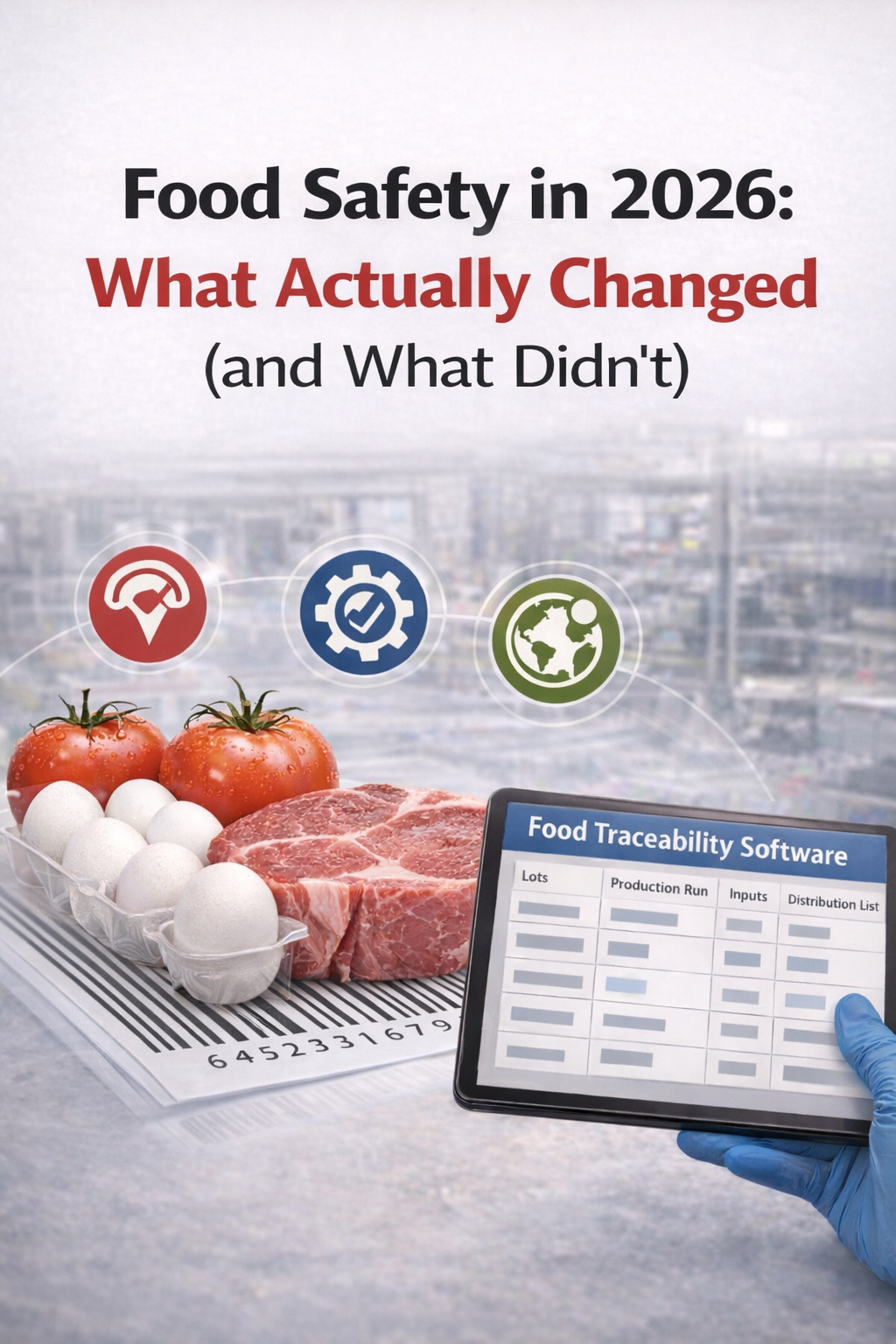
Step 3 — Make traceability recall-ready, not just compliant
Stop thinking “one step back/forward” as the finish line. Treat it as the minimum.
Build a traceback model you can execute fast:
-
Finished goods lot ↔ production run ↔ inputs lots ↔ supplier lots ↔ shipment/customer lots
Example (leafy greens / ready-to-eat produce):
-
Incoming lot is scanned/recorded at receiving
-
It is assigned to a production run
-
That run generates finished lot codes
-
Each shipment references finished lots
-
A recall can be narrowed to specific days/runs, not “everything in the building”
This is where Food traceability software becomes a serious advantage: it reduces manual linking errors and makes retrieval fast when time matters.
Step 4 — Define “evidence standards” for records (and enforce them)
Decide what “good evidence” looks like—then standardize it.
For every critical record type, define:
-
required fields (no blanks),
-
time of completion (real-time vs end of shift),
-
who signs (role-based),
-
acceptable corrections,
-
retention and retrieval rules.
Example (cooking CCP log):
-
Must capture actual temperature and hold time
-
Must tie to product code + lot
-
Must record corrective action immediately if out of spec
-
Must prevent “silent edits” after the fact
This is why digital systems win: they can enforce required fields, timestamps, user attribution, and revision history automatically—things paper can’t reliably do under pressure.
Step 5 — Build a “2-hour recall capability”
This is a powerful executive metric: Can we produce a recall-ready lot list and distribution list within 2 hours?
Run quarterly mock recalls with escalating difficulty:
-
normal weekday
-
weekend shift
-
missing staff
-
supplier data confusion
-
rework involved
-
mixed pallets involved
Grade yourself on:
-
time to scope,
-
confidence level,
-
proof quality,
-
communication speed.
If it takes 2 days to gather records, you don’t have traceability—you have archive storage.
Step 6 — Operationalize continuous improvement (not “annual review theater”)
Use near-misses, complaints, and internal deviations as improvement fuel.
Set a monthly routine:
-
top 5 recurring deviations
-
top 5 customer complaints
-
top 5 sanitation findings
-
corrective actions + verification of effectiveness
Example:
If you repeatedly see “label check missed at changeover,” don’t just retrain.
Fix the system:
-
add a poka-yoke step,
-
require a second-person verification,
-
add a line-start checklist gate.
Step 7 — Decide what to digitize first (quick wins)
If you’re moving toward food safety software, don’t digitize everything at once. Start where ROI is obvious:
Best first modules:
-
corrective actions (CAPA)
-
inspections & pre-op
-
CCP/PC monitoring
-
traceability/lot linking
-
supplier approvals and COA management
Quick win example:
Digitize pre-op inspections with forced photo evidence and automatic escalation if “fail” is selected.
You’ll see immediate impact in:
-
sanitation accountability,
-
faster corrective actions,
-
audit readiness.
Where leaders are winning in 2026
The strongest food safety organizations are doing three things consistently:
-
They build systems that work under stress, not just during audits.
-
They treat traceability as a business capability, not a regulatory burden.
-
They invest in evidence quality—because that’s what holds up in disputes, recalls, and customer scrutiny.
Want to see what this looks like in practice?
If you want a practical walkthrough of how a modern system can tighten execution, speed up traceability, and reduce record failure modes, book a demo here: https://normex.ca/demo.
You’ll get a clear view of how to structure digital records, automate accountability, and keep your program audit-ready every day—not just when someone is coming.