It usually starts with a phone call that feels too calm for the problem it carries.
A customer complaint. A lab result. A retailer question. A regulator request. Sometimes it’s an internal red flag—someone on the floor notices an ingredient label doesn’t match the spec, or a receiving tag looks wrong, or a rework bin is missing its lot identification.
Then the sentence lands:
“We need to know exactly what went into this product—and where it went.”
In that moment, every food business discovers the truth about its traceability program. Not the policy. Not the SOP. Not the PowerPoint used during audits.
The truth is what you can produce under pressure, with the clock running, while senior leadership watches, and the risk is no longer theoretical.
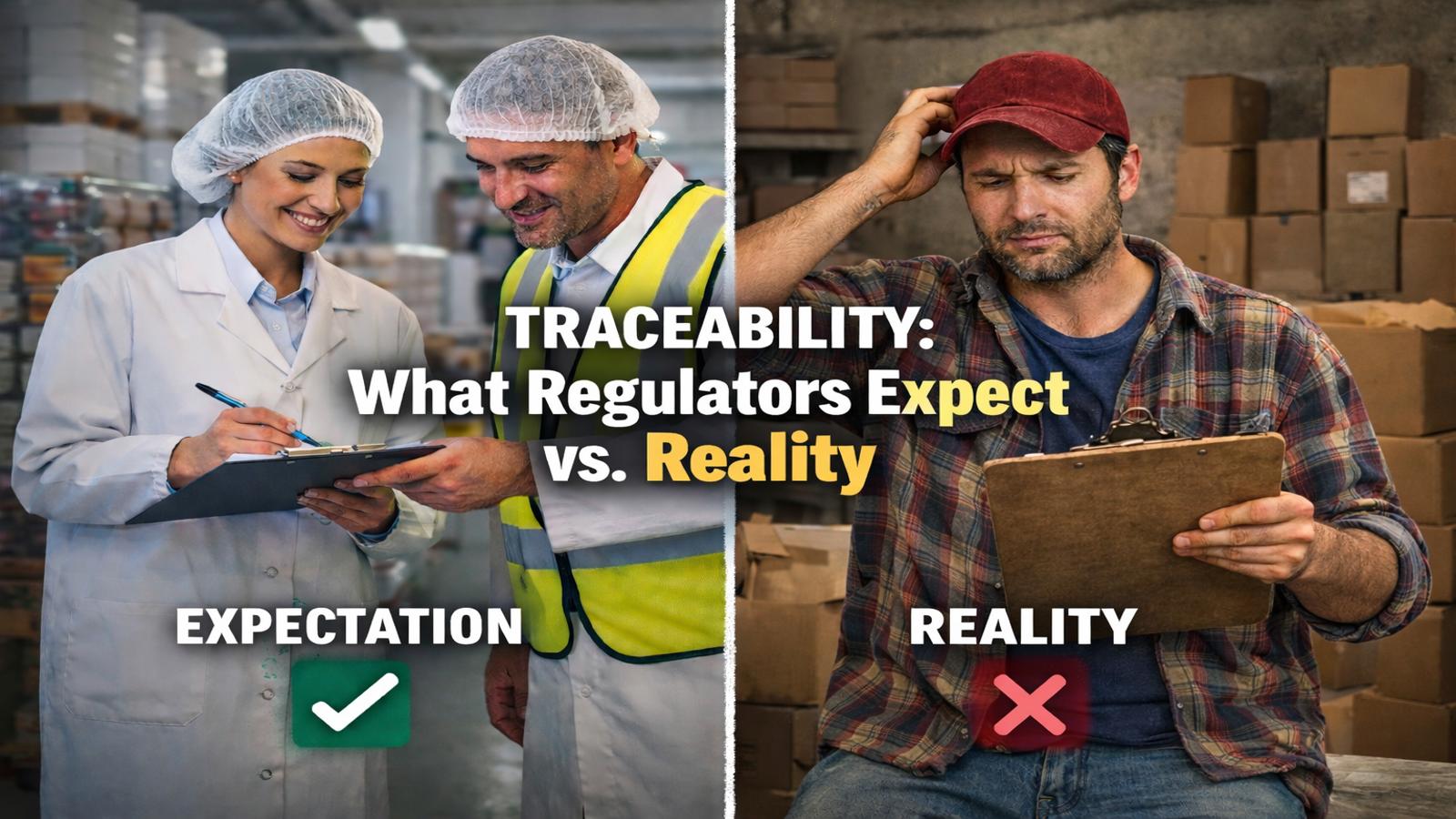
This is where the gap between what regulators expect and what actually happens in real operations becomes painfully clear.
Because regulators don’t grade your intentions. They grade your evidence.
And evidence is either traceable—or it’s not.
The Regulator Expectation: Traceability as a Capability, Not a Binder
Most regulators frame traceability as a fundamental control for Food safety. The logic is simple:
When something goes wrong, you need to contain it quickly, identify impacted product accurately, and prove what happened. That is how you protect consumers and limit harm.
So what do regulators expect?
1) Speed: “Show me in minutes, not days.”
When a regulator asks for traceability, they are not asking whether you could reconstruct it if you locked a team in a room for two days.
They want to see that you can:
-
identify the lot history fast,
-
trace one step back (suppliers/inputs),
-
trace one step forward (customers/shipments),
-
and do it with confidence and consistency.
Speed matters because delays create uncertainty—and uncertainty expands recalls.
2) Accuracy: “Don’t make me guess.”
Traceability records must be:
-
legible,
-
complete,
-
internally consistent,
-
and linked logically across receiving → production → packaging → shipping.
When lot codes don’t match, when dates don’t line up, when “Line 2” is written as “L2” and sometimes “Packaging,” you may still be operating—but your traceability chain is fragile.
3) Scope: “Prove the whole chain.”
Regulators expect traceability across the full flow:
-
incoming materials (ingredients, packaging, processing aids)
-
internal movements and transformations (rework, splits, mixing, holds)
-
finished product lots
-
distribution and shipping
This is where many programs break: traceability in theory often ignores the messy middle—rework, partial pallets, staged WIP, relabeling, and last-minute substitutions.
4) Integrity: “Show me you didn’t backfill.”
In a serious event, a regulator may look for evidence that records are created at the time of activity, not after the fact.
Paper systems make this hard. So do spreadsheets. Even when people are honest, it’s difficult to prove integrity when entries can be added later without an audit trail.
5) Repeatability: “It should work on Tuesday night, not only during audit week.”
A traceability program that only works when your best people are present is not a program—it’s a dependency.
Regulators expect a system that can be executed consistently, across shifts, regardless of who is working.
Reality: Traceability Is Often a Patchwork of Good Intentions
Now let’s talk about what really happens inside most food businesses—not because they don’t care, but because operations are complicated.
Here is the reality gap, and why it exists.
Reality #1: Lot capture is inconsistent at receiving
Receiving is one of the most chaotic points in any facility:
-
multiple deliveries,
-
multiple formats (totes, bags, pails, drums, pallets),
-
time pressure,
-
dock congestion,
-
paperwork mismatches.
If lot numbers aren’t captured properly at receiving—cleanly, consistently, in a structured format—then everything downstream becomes guesswork.
And a shocking number of plants rely on:
-
handwritten notes,
-
photos of tags,
-
partial entries,
-
or “we’ll fix it later.”
“Later” is where traceability goes to die.
Reality #2: Production transforms ingredients… and the records don’t keep up
Mixing, blending, batching, rework, hold-and-release, repacking—this is where traceability becomes complex.
In reality:
-
rework is sometimes logged loosely,
-
partial lots are combined without clean links,
-
substitutions happen (“we ran out, we used the other one”),
-
and labels get printed based on what should have been used, not what actually was.
This is not a moral failure. It’s a system failure: the recordkeeping method is not designed for operational truth.
Reality #3: Shipping records aren’t always connected to production lots
Many organizations can show:
-
what they produced (sort of),
-
and what they shipped (sort of),
-
but the connection between finished lot and customer shipment is incomplete.
So in an incident, they either:
-
recall too much (expensive), or
-
recall too little (dangerous).
Reality #4: Traceability lives in people, not in the system
The most common “solution” I see in the wild is this:
“Don’t worry, John knows where everything is.”
That’s not traceability. That’s tribal knowledge.
And when John is sick, on vacation, or leaves the company, your risk profile changes overnight.
Reality #5: “Hybrid” systems create blind spots
A little paper. A few Excel files. A folder of PDFs. An ERP that covers inventory but not food safety records. A QA binder for inspections. Another tool for shipping.
Each part makes sense alone. Together, they create a traceability chain with breaks—breaks you don’t notice until the day you need speed and certainty.
A Story from the Real World: The Two-Hour Clock
Imagine this:
A regulator calls and requests a traceability exercise for a finished product lot produced last week. You have two hours to provide:
-
supplier lots of key ingredients
-
packaging lots
-
the production date/time/line
-
associated CCP/CP records
-
sanitation records for the relevant window
-
distribution list (where it shipped)
Your team starts strong. They pull the batch record. They find most of the ingredient info. Then they hit the first crack:
-
The lot code is smudged on the receiving sheet.
-
The packaging lot is missing because someone used the wrong clipboard.
-
The rework used in the batch isn’t linked to its original lot.
-
Shipping shows customer orders, but the finished lot assignment is unclear.
-
The QA manager realizes they can answer… but not prove.
That last part is the killer.
In food safety, “I’m pretty sure” is not a defensible position.
So the team does what teams always do under pressure:
-
they reconstruct,
-
they interpret,
-
they cross-reference,
-
they fill gaps with best guesses,
-
and they hope it’s good enough.
Sometimes it is.
But from a regulator’s perspective, it reveals something important:
You don’t have traceability. You have a traceability effort.
And effort collapses under stress.
What “Good” Looks Like: Traceability as a Designed System
The organizations that handle traceability well treat it like a designed capability, not a compliance checkbox.
They build four pillars:
-
Structured data capture at receiving, production, and shipping
-
Lot linking across transformations (including rework)
-
Searchable records that can be queried fast
-
Audit trail and integrity so records are defensible
This is where modern Food traceability software (or broader food safety software) earns its place: it turns traceability from a manual investigation into a repeatable workflow.
Step-by-Step: How to Close the Gap Between Expectation and Reality
Here’s a practical approach that works whether you’re improving a paper-based program or implementing a digital system.
Step 1 — Define your traceability “units”
Be explicit about what you trace:
-
ingredients (by supplier lot)
-
packaging (by lot, where relevant)
-
processing aids (if risk-relevant)
-
rework (by source lot and date)
-
finished product (by internal lot)
If you don’t define your units clearly, people will “do their best,” and best efforts won’t be consistent.
Example:
Sugar may arrive in both totes and 20 kg bags with the same item code. If formats differ, record them as separate traceable units with clear conversion logic.
Step 2 — Standardize receiving lot capture
Receiving must capture, at minimum:
-
supplier name
-
supplier lot code
-
internal lot code (if you assign one)
-
quantity + format (bags, totes, cases)
-
date/time received
-
storage location (optional but powerful)
-
COA / spec reference (where applicable)
Then enforce this: no lot captured = no material released for production.
It sounds strict. It’s also the only way to keep the chain clean.
Step 3 — Build production lot linking into the workflow
For each batch/run, capture:
-
which input lots were used
-
how much of each was used
-
what rework (if any) was added, including its source lot
-
what line, shift, and time window applied
-
who verified the run
Example:
Batch #2026-021:
-
Flour lot A123 (800 kg)
-
Eggs lot E889 (120 kg)
-
Rework lot RW-2026-017 (35 kg, from finished lot F-2026-010)
Now traceability becomes a chain, not a pile of documents.
Step 4 — Connect CCP/CP and sanitation records to the same timeline
Regulators don’t only want “what went in” and “where it went.”
They want to know:
-
were controls met during that production window?
-
were deviations captured and addressed?
-
did sanitation verification occur for that line/room/equipment?
If those records live in separate binders with no link to the lot timeline, you’re forced to manually stitch them together under pressure.
Digitally, this is where a food safety software platform shines: it creates a single story, tied to time and product.
Step 5 — Close the shipping loop
You need the ability to answer:
-
which customers received lot F-2026-010?
-
how much did they receive?
-
when was it shipped?
-
through which carrier?
This is the “one step forward” proof.
Example:
Lot F-2026-010 shipped to:
-
Customer X: 200 cases, Jan 22
-
Customer Y: 80 cases, Jan 23
If you can’t do this quickly, your recall scope explodes.
Step 6 — Run monthly mock traceability exercises
Don’t wait for an audit. Test your system regularly.
Pick one finished lot and ask your team to produce:
-
one step back
-
one step forward
-
control records (CCP/CP, sanitation)
-
corrective actions (if any)
Measure:
-
time to complete
-
gaps found
-
root causes of gaps
-
corrective actions to prevent recurrence
This turns traceability into muscle, not theory.
Step 7 — Decide: paper forever, or digital for real
This is the leadership decision.
If you stay paper-based, accept the tradeoff:
-
higher labor cost,
-
slower response,
-
more uncertainty,
-
more stress,
-
and more dependence on individuals.
If you go digital, do it fully—not halfway—so you get:
-
structured capture,
-
searchable traceability,
-
audit trails,
-
and real-time visibility.
The middle ground is what creates false confidence.
The Executive Reality: Traceability Is a Brand Protection System
For C-level leaders, traceability is not a technical detail. It’s a risk and reputation system.
When an incident happens, your performance is judged by:
-
how fast you respond,
-
how precisely you isolate impact,
-
how confidently you communicate,
-
and how credible your evidence is.
Strong traceability reduces:
-
recall scope,
-
downtime,
-
customer fallout,
-
legal exposure,
-
and regulator escalation.
Weak traceability magnifies all of it.
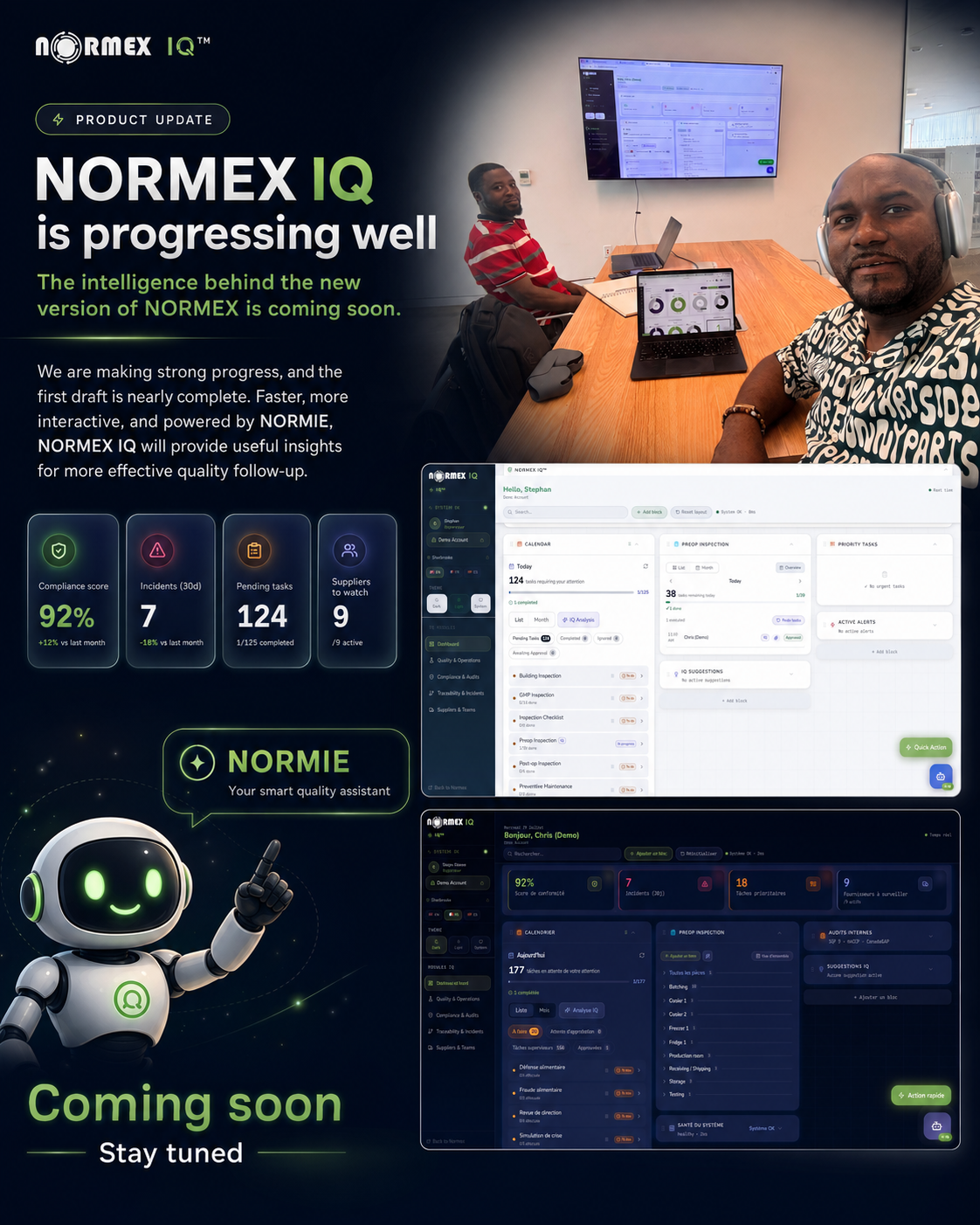
Want to See What “Audit-Proof Traceability” Looks Like?
If you want to see how modern Food traceability software can close the gap between regulator expectations and operational reality, book a demo here:
Bring one real scenario (a product, a lot, a typical batch flow, and how you currently capture receiving/production/shipping). The goal isn’t a generic software tour—it’s to show what traceability looks like when it’s designed to work under pressure.