
Paper vs Digital: There Is No Middle Ground
There’s a familiar moment in almost every food plant, warehouse, or distribution operation.
It’s 4:47 p.m. on a Friday. A truck is waiting. The QA lead is halfway out the door. Someone from operations walks in with the kind of face that signals, something is wrong. Not catastrophic. Not yet. But wrong enough to pull everyone back into the building.
A customer has flagged a potential issue: a label mismatch. Or a temperature log looks suspicious. Or an allergen statement doesn’t match what’s in the finished product. The request is simple, at least on paper:
“Show me your records. Prove what happened. And prove it fast.”
So the hunt begins.
A binder gets opened. Then another. Someone checks a clipboard. Someone texts a supervisor for a picture of a sheet that was “definitely filled out.” The maintenance log is in a different office. The receiving lot code is written in pen, but the handwriting is questionable. The corrective action form exists… somewhere. And the “most recent version” of the SOP might be the one printed three months ago, or the one updated last week and emailed to only half the team.
Minutes turn into an hour. Then two. And during that time, something bigger is happening quietly in the background:
Confidence is eroding.
Not because your team doesn’t care. Not because you don’t take Food safety seriously. But because your system—paper, partial spreadsheets, mixed processes, and workarounds—can’t keep up with the reality of modern operations.
That’s why the title of this conversation is uncomfortable but true:
Paper vs Digital: There Is No Middle Ground
“Hybrid” sounds reasonable. It sounds like a practical compromise. A gentle transition. A stepping stone.
In real life, hybrid becomes the worst of both worlds:
-
Paper creates gaps you can’t see until you need answers.
-
Digital fragments (files, Excel, disconnected tools) create a false sense of control.
-
People compensate with memory, heroics, and overtime.
-
And leadership assumes the risk is handled—until the day it isn’t.
This isn’t a debate about preference. It’s about system design under pressure.
Why “Middle Ground” Fails in Food Operations
Food businesses are complex systems. They involve:
-
multiple shifts
-
turnover and training variance
-
suppliers and changing specs
-
regulatory expectations
-
customer audits
-
traceability timelines
-
preventive programs
-
a constant push for productivity
Paper-based systems can work when:
-
the operation is small,
-
the product risk is low,
-
the team is stable,
-
and nobody needs answers quickly.
But modern supply chains don’t allow that comfort.
The moment you mix paper with a bit of digital, something predictable happens:
1) Version control collapses
Which SOP is the current one? Which form is approved? Who changed it? When did it go live?
Paper can’t answer those questions reliably. And scattered PDFs on a shared drive don’t either.
2) Data integrity becomes unprovable
When an auditor (or customer) asks, “How do you know this wasn’t changed after the fact?” paper gives you no clean proof.
You can be honest and still look exposed.
3) Response speed becomes a liability
In a traceability event, speed isn’t a convenience. It’s containment.
The longer you take to identify affected lots, the wider the blast radius—financially and reputationally.
4) Leadership loses visibility
C-level leaders don’t need more binders. They need:
-
trend lines
-
leading indicators
-
proof of control
-
predictable audit readiness
-
risk reduced before it costs money
Paper hides problems until they become expensive.
The Real Cost of Paper Isn’t Paper
Most companies underestimate paper because they only count obvious costs:
-
printing
-
binders
-
storage
-
admin time
That’s not where the real cost lives.
The real cost of paper lives in:
-
missed deviations (because nobody saw patterns)
-
slow investigations
-
repeat issues (because lessons don’t travel across shifts)
-
audit panic (because readiness isn’t real, it’s rehearsed)
-
weak accountability (because ownership is unclear)
-
lost time (because searching becomes a daily habit)
Paper doesn’t just “store information.” It stores it in a way that makes it hard to use when it matters most.
And in food, “when it matters most” is not theoretical.
It’s the phone call.
The audit.
The complaint.
The export hold.
The allergen scare.
The temperature excursion.
The recall.
Digital Isn’t About Convenience. It’s About Control.
When food organizations go digital the right way, the value isn’t that forms look nicer. The value is that the system starts behaving like a real control framework:
-
You can’t use the wrong form.
-
You can’t complete a record without required fields.
-
Out-of-spec triggers actions automatically.
-
Corrective actions are tracked, assigned, and visible.
-
Data becomes searchable, reportable, and auditable.
-
Trends surface before they become incidents.
That’s why a true food safety software platform changes the operating posture from reactive to controlled.
It reduces risk the same way automation reduces mistakes:
not by hoping people try harder, but by designing a system that doesn’t rely on perfect behavior.
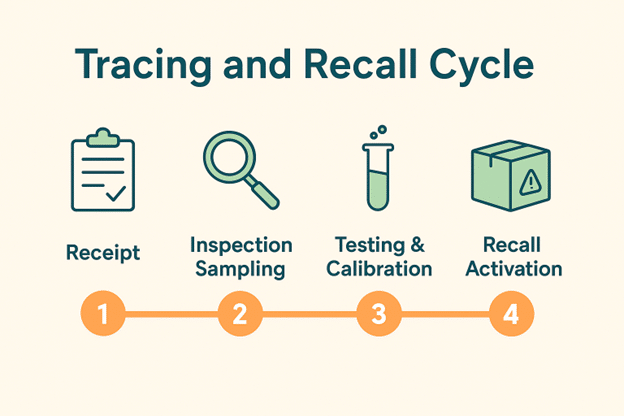
A High-Impact Example: The Traceability Clock
Let’s make this concrete.
A customer reports a problem with a finished product batch. They provide a lot code. You need to know:
-
What raw materials went into it?
-
Which supplier lots were used?
-
Which production line and shift ran it?
-
What sanitation record applies?
-
What CCP/CP checks were recorded?
-
Where did the product ship?
-
What other finished lots share the same inputs?
On paper, answering this often takes hours—sometimes days—because it requires:
-
pulling multiple binders,
-
matching handwritten lot codes,
-
hoping the handwriting is readable,
-
reconciling receiving logs with production sheets,
-
and verifying shipments in yet another system.
Digitally—done properly—this becomes a structured query. Your organization can respond in minutes, not because the team is smarter, but because the system is built for reality.
That’s the difference between having records and having control.
This is exactly where Food traceability software stops being a buzzword and becomes a strategic advantage.
The Myth: “We’re Not Ready to Fully Go Digital Yet”
This sentence sounds responsible. It sounds risk-managed.
But most of the time, it’s actually a form of delay caused by fear of disruption.
The truth is blunt:
-
You are already disrupted—just quietly.
-
You are paying a daily tax in inefficiency and hidden risk.
-
And you’re betting your brand on your team’s ability to patch holes under pressure.
Going fully digital isn’t “a big IT project.” It’s a leadership decision:
Do we want a system that scales, or do we want to keep relying on people to compensate for system weaknesses?
Step-by-Step Approach: How to Move from Paper to Digital Without Chaos
A full digital transition doesn’t need to be dramatic. But it must be deliberate. Here’s a practical step-by-step path that works in real facilities:
Step 1 — Map the “moments of truth”
Identify the events where your system is tested:
-
audits
-
customer complaints
-
deviations
-
traceability requests
-
sanitation failures
-
allergen controls
-
supplier issues
List what information you must produce quickly during those moments. That becomes your digital priority list.
Step 2 — Standardize and simplify your forms
Most paper systems become bloated over time. Before digitizing, clean up:
-
duplicate checks
-
unnecessary fields
-
inconsistent formats
-
“we’ve always done it this way” records
Digitizing a messy process just creates digital clutter.
Step 3 — Digitize the highest-risk, highest-frequency records first
Start where the risk and volume justify it:
-
CCP/CP monitoring
-
sanitation and pre-op checks
-
receiving and lot capture
-
non-conformities and corrective actions
-
training records tied to tasks
These areas generate the biggest ROI quickly because they touch daily execution.
Step 4 — Build automatic triggers for out-of-spec events
This is where paper collapses: people notice late, or not at all.
Digital systems should:
-
flag out-of-range values instantly
-
assign corrective actions
-
require verification and closure
-
create an audit trail automatically
Step 5 — Create visibility for management
C-level and plant leadership need dashboards that answer:
-
What’s trending worse?
-
What keeps repeating?
-
Where are we exposed this week?
-
Are we audit-ready right now—or “audit-ready if we panic”?
Visibility reduces surprise. Surprise is expensive.
Step 6 — Train by role, not by software
People don’t need to “learn the platform.”
They need to learn what changes in their day:
-
how to record checks
-
what happens when there’s a deviation
-
how to close actions
-
who is accountable
Adoption succeeds when workflows are clear.
Step 7 — Lock the system: no parallel paper
This is the hard part—and the part most companies avoid.
As long as paper exists as a backup, people will use it when:
-
they’re busy,
-
the shift is short-staffed,
-
someone forgets a login,
-
or they want to “do it later.”
That’s the “middle ground,” and it will quietly destroy your data quality.
Set a cutover date. Support the transition. And commit.
“But What If the System Goes Down?”
This is a fair concern—and it’s exactly why serious platforms build for reliability:
-
controlled access
-
backups
-
audit trails
-
permissions
-
structured exports
-
consistent version control
Paper feels safe because it’s tangible. But tangibility isn’t the same as resilience.
Paper is vulnerable to:
-
missing pages
-
damaged binders
-
illegible entries
-
backfilling
-
inconsistent storage
-
silent non-compliance
Digital risk is visible and manageable. Paper risk is invisible until it hurts you.
The Bottom Line: Food Safety Is Too Serious for Half Measures
Food operations don’t fail because people don’t care.
They fail because systems are built for a slower world.
If you’re still relying on paper, or living in hybrid limbo, here’s the truth:
You might be passing audits.
You might be producing safe product.
You might be fine—today.
But the margin for error is shrinking.
Customer expectations are rising.
Regulatory pressure isn’t easing.
And supply chain complexity isn’t going backwards.
This is why there is no middle ground.
Paper is a system built on trust and effort.
Digital is a system built on control and proof.
And in food, proof wins.
Want to See What “Full Digital” Looks Like in Practice?
If you want to explore how a modern food safety software approach can work in your operation—without chaos, and without adding complexity—book a demo here:
Come with one real scenario (audit prep, traceability, sanitation control, corrective actions, or training). The best demos aren’t generic—they’re built around the pressure moments your team actually faces.