Audit season has a way of showing who’s running a controlled system—and who’s been “getting by” on good intentions.
If you’re a food manufacturer, importer, processor, packer, distributor, or co-man, you already know the rhythm: customer audits, GFSI audits, regulatory inspections, internal audits, supplier verification, mock recalls, traceability tests, and corrective action follow-ups. They don’t arrive politely when you feel prepared. They arrive when your schedule is full, your team is stretched, and operations are moving fast.
So here’s the real question: are you ready—or just hoping?
Hope sounds like:
-
“We did it last year, we’ll figure it out again.”
-
“The binder should be in the office somewhere.”
-
“Let’s ask Marie, she knows where the records are.”
-
“We’ll clean up the logs this weekend.”
Readiness sounds like:
-
“Our records are complete, time-stamped, and easy to retrieve.”
-
“Our CCP checks are consistent and verified.”
-
“Training is current and signed.”
-
“We can trace forward and backward in minutes.”
-
“Deviations trigger CAPAs, and CAPAs are tracked to closure.”
Audits don’t just check whether you have programs. They test whether you can prove control, prove consistency, and prove follow-through—under pressure.
Below is a deep breakdown of what “audit-ready” actually means, the most common failure points, and a step-by-step approach (with practical examples) to move from scrambling to confidence—using strong process discipline and, where it makes sense, food safety software to reduce risk and workload.
What Auditors Are Really Testing (Even When They Don’t Say It)
Most audit standards and regulatory frameworks differ in structure, but auditors tend to evaluate the same core things:
1) Evidence of control
It’s not enough to say you monitor temperatures, allergens, sanitation, pest control, or supplier documents. They want evidence:
-
Records (complete, legible, dated, signed)
-
Defined frequencies
-
Defined limits and acceptance criteria
-
Verification activities (not just monitoring)
-
Escalation pathways when something is off
2) Consistency across shifts, sites, and people
If one supervisor runs a tight ship but the night shift is improvising, the system isn’t stable. Audits expose variation.
3) Traceability and recall readiness
Traceability is not a “paper exercise.” Auditors want proof you can:
-
Identify affected lots fast
-
Know where product went
-
Know what came in (ingredients, packaging, suppliers)
-
Execute a recall or withdrawal procedure without chaos
4) Corrective action maturity
Many plants can identify problems. Fewer can prove they:
-
Investigated root cause properly
-
Implemented effective corrective actions
-
Prevented recurrence
-
Verified effectiveness
5) Management involvement
C-level leadership doesn’t need to memorize HACCP decision trees. But auditors expect leadership to show:
-
Awareness of risk and performance
-
Resource allocation
-
Accountability
-
Food safety culture (not just posters)
The Biggest “Audit Season” Traps (That Cost Findings)
Here are the issues that repeatedly turn into non-conformances:
Trap A: “We have the record… somewhere.”
Scattered records across clipboards, binders, shared drives, and personal desktops create delays and gaps. In an audit, delay looks like weakness.
Trap B: Backfilled or edited records
If forms are filled days later, or handwriting suddenly changes, or records look “too perfect,” auditors start asking harder questions.
Trap C: SOPs exist, but people don’t follow them
A procedure that isn’t operationally realistic becomes a liability. Auditors interview operators for a reason.
Trap D: Supplier approvals are incomplete
Missing COAs, expiry dates not tracked, supplier questionnaires not current, or no documented review of high-risk suppliers.
Trap E: Traceability is theoretical
You have a written program, but when asked to trace a lot, it takes half a day and five phone calls.
Trap F: CAPAs are weak or not closed
“Retrained staff” is not a root cause. It’s a band-aid. Auditors want cause-and-effect logic.
Step-by-Step: From “Audit Panic” to “Audit Ready”
This approach is designed for food safety leaders and C-level teams who want fewer surprises and less fire-fighting.
Step 1 — Define your audit scope and calendar (don’t guess)
List what’s coming and what it covers:
-
Regulatory inspection (CFIA/FDA/state/provincial)
-
GFSI (SQF, BRCGS, FSSC 22000)
-
Customer audits
-
Internal audits
-
Supplier audits (or remote assessments)
Action: Create a single audit season timeline with:
-
Audit date
-
Standard/version
-
Site(s) included
-
Product categories included
-
Previous major/minor findings
-
“Known pain points” (traceability, sanitation records, allergen control, etc.)
Example: If last year you got a major on allergen changeover verification, that’s not a “quality issue.” That’s a system risk. It should become a focused readiness project with verification proof.
Step 2 — Build your “Audit Evidence Map”
Think like an auditor. For every key program area, document:
-
What is the procedure?
-
What is the record that proves it happened?
-
Where is that record stored?
-
Who owns it?
-
How quickly can you retrieve 3 months of evidence?
Core areas usually include:
-
HACCP / Preventive Controls plan
-
CCP/PC monitoring and verification
-
Calibration
-
Sanitation and pre-op
-
Environmental monitoring (if applicable)
-
Allergen management
-
Receiving and supplier approval
-
Traceability and mock recall
-
Training and competency
-
Maintenance and preventive maintenance
-
Pest control
-
Non-conformance handling and CAPA
Action: For each area, test retrieval today:
-
“Show me the last 10 pre-op records.”
-
“Show me the last calibration record for thermometer X.”
-
“Show me the allergen cleanup verification for Line 2 from last month.”
If retrieval takes more than a few minutes, you’re not ready—you’re searching.
Step 3 — Run a “Record Reality Check” (completeness + credibility)
Auditors look for patterns:
-
Missing initials
-
Missing times
-
Records done in batches
-
No corrective action when limits were exceeded
-
Corrections not signed/dated
-
Verification missing (especially supervisor verification)
Action: Sample records the way auditors do:
-
Pick random days across different shifts
-
Pick one CCP and follow it end-to-end for a week
-
Compare monitoring results to corrective actions and disposition records
Example: A cooler log shows 9°C for three checks. If there’s no product hold, no corrective action, and no verification of product safety, you’ve created a major risk finding.
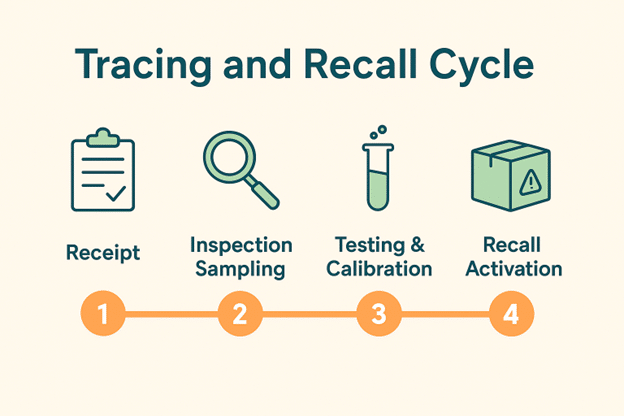
Step 4 — Pressure-test traceability (don’t wait for the audit)
This is where many companies “hope.”
Action: Run a mock trace every month during audit season:
-
Choose a finished product lot
-
Identify all ingredients and packaging lots used
-
Identify all customers/shipments that received it
-
Pull supporting records (receiving, production, shipping)
-
Time the process
-
Document gaps and actions
Goal: Be able to produce a clear trace report fast—with evidence.
This is where Food traceability software can dramatically reduce friction: centralized lot capture, standardized receiving/production/shipping logs, and faster reporting.
Example: If your trace requires digging into handwritten receiving logs, Excel batch sheets, and shipping paperwork, you’ll lose time and expose gaps. A digital system that forces lot entry and links ingredients to finished goods shrinks the chaos.
Step 5 — Strengthen CAPA quality (root cause, not excuses)
A solid CAPA answers:
-
What happened?
-
What product/process was impacted?
-
Immediate correction (containment)
-
Root cause (why it happened)
-
Corrective action (fix the cause)
-
Preventive action (stop recurrence)
-
Verification of effectiveness (proof it worked)
-
Closure and sign-off
Action: Review the last 10 non-conformances and ask:
-
Are root causes real, or generic?
-
Are actions measurable?
-
Is there evidence of verification?
Example of weak root cause: “Employee forgot.”
Better root cause: “No standardized visual cue for allergen changeover verification; training not linked to competency check; supervisor verification not defined.”
Step 6 — Prepare your “Audit Day Playbook”
Audit day is not the time for improvisation.
Action: Create a playbook that includes:
-
Who greets the auditor
-
Where records are pulled from
-
Who escorts the auditor on the floor
-
Rules for interviews (truthful, direct, no guessing)
-
How to handle “I don’t know” (answer: “I’ll confirm and come back with evidence.”)
-
A live “request log” to track what was asked and what was provided
Example: If auditors ask for “last 3 months of sanitation verification,” you should know exactly who pulls it, where it lives, and how it’s packaged cleanly.
Step 7 — Decide what to digitize (and be ruthless about ROI)
Not everything needs a fancy system. But some things are too critical to keep on paper if you want consistent readiness.
High-impact areas to digitize first:
-
CCP monitoring + verification
-
Sanitation and pre-op
-
Allergen checks
-
Receiving inspections + supplier docs + expiry tracking
-
Training matrix + sign-offs
-
Non-conformance and CAPA tracking
-
Traceability (ingredient-to-finished-lot linkage)
The ROI isn’t just “time saved.” It’s:
-
Reduced audit findings
-
Reduced recall risk
-
Faster investigations
-
Better accountability across shifts
-
Less dependency on “one person who knows everything”
That’s why many teams move toward food safety software: not to “look modern,” but to reduce operational risk and make audits boring—in the best way.
What “Audit Ready” Looks Like in Practice (Mini Scenarios)
Scenario 1: Temperature deviation at receiving
Not ready: Receiving logs show a temperature out of spec. No action recorded. Product still used.
Audit ready: Receiving inspection triggers automatic hold, documented disposition, supplier notification if needed, and corrective action logged.
Scenario 2: Allergen changeover
Not ready: SOP exists, but verification records are inconsistent and not reviewed.
Audit ready: Standardized checklist per line, verification sign-off, periodic validation, and training tied to role.
Scenario 3: Supplier document expiry
Not ready: COAs and certificates are saved in emails, expiry dates not tracked.
Audit ready: Supplier approval requires mandatory documents, expiry alerts, and a clear “approved/conditional/blocked” status.
The Hard Truth: Hoping Is a Strategy That Fails Under Pressure
If your audit readiness relies on:
-
heroics,
-
last-minute weekends,
-
and tribal knowledge,
then you’re one resignation, one sick day, or one busy production week away from a painful audit.
The fix isn’t “work harder.” It’s build a system that produces proof as a byproduct of doing the work.
That means:
-
clear standards,
-
consistent records,
-
fast retrieval,
-
real CAPAs,
-
traceability you can execute,
-
and leadership that treats Food safety as operational performance—not paperwork.
Want to See What “Audit Ready” Looks Like in a Real System?
If you want to reduce audit stress, tighten traceability, and stop chasing records across binders and spreadsheets, book a demo and see a practical setup built for real operations: