
Manual food safety records look cheap—until you measure what they actually cost.
A clipboard, a few binders, and “we’ve always done it this way” can feel familiar and controlled. But for most food businesses, manual recordkeeping quietly creates a tax on every department: quality, operations, maintenance, warehousing, leadership, and even sales. It steals time, adds risk, weakens traceability, and turns audits into stressful fire drills.
This article breaks down the true cost of manual records in detail—financial, operational, and strategic—then gives you a step-by-step approach (with examples) to modernize without chaos. If you’re a food safety leader or a C-level executive, this is the part most teams never quantify… and where the biggest wins are hiding.
What “Manual Records” Really Means (It’s More Than Paper)
When people say “manual records,” they usually mean paper checklists and handwritten logs. But the real definition is broader:
-
Paper forms: temperature logs, sanitation pre-ops, metal detector checks, allergen changeover checks
-
Spreadsheets: CCP monitoring, corrective actions, supplier approvals
-
Text messages / emails: “I confirmed it,” “we cleaned it,” “here’s a photo”
-
Filing cabinets and shared drives: scanned PDFs, versions named “FINAL_final2.pdf”
-
Human memory: “I’m pretty sure we did it”
The common thread is that the system depends on people being perfect every day—and on documents being easy to find when the pressure hits.
That’s not a system. That’s hope.
The Cost Categories Most Companies Underestimate
1) Labor Cost: The Hidden Payroll Drain
Manual recordkeeping consumes time in small pieces that rarely show up as “extra work,” but it’s constant:
-
Filling out logs
-
Walking to boards/folders
-
Chasing signatures
-
Correcting missing fields
-
Rewriting messy entries
-
Scanning and uploading
-
Filing
-
Searching during audits
-
Recreating lost records
Example (simple math, real impact):
If 15 employees spend 10 minutes/day on manual logs and follow-ups, that’s:
-
15 × 10 minutes = 150 minutes/day = 2.5 hours/day
-
2.5 hours × 260 workdays ≈ 650 hours/year
-
At a fully loaded labor cost of $35/hour, that’s ~$22,750/year for just 10 minutes/day.
Most plants are not at 10 minutes/day. Many are at 30–90 minutes/day across roles once you include review, filing, and audit prep.
And that’s before you count the time wasted when records are wrong.
2) Error Cost: Manual Systems Don’t Fail Loudly—They Fail Silently
Manual logs create predictable failure modes:
-
Backfilling (logs filled hours later or “at end of shift”)
-
Pencil-whipping (“everything is fine” without verification)
-
Missing entries (someone forgot; shift changed; binder moved)
-
Unclear handwriting
-
Wrong units (°F vs °C, ppm vs %)
-
No corrective action linkage (a deviation exists but nothing shows what was done)
The cost is not only the mistake. It’s what the mistake triggers:
-
Investigation time
-
Repeat checks
-
Product holds
-
Rework
-
Scrap
-
Customer complaints
-
Audit nonconformities
Manual records are like driving without a dashboard: you only learn there was a problem when smoke comes out.
3) Audit Cost: “Audit Prep Mode” Is Operational Debt
Ask a QA manager what happens two weeks before an audit. You’ll hear the same pattern:
-
“We pull everything from binders.”
-
“We scan what’s missing.”
-
“We chase production for signatures.”
-
“We reorganize.”
-
“We print extra.”
-
“We stay late.”
That scramble is not “normal work.” It’s the price of an information system that’s not built for retrieval.
The real audit cost is opportunity cost:
Instead of improving preventive controls, training, sanitation effectiveness, or supplier programs, your best people are stuck doing document archaeology.
C-level leaders should see this clearly: when your team spends weeks preparing evidence of control, that’s a sign the system is not producing control—just paperwork.
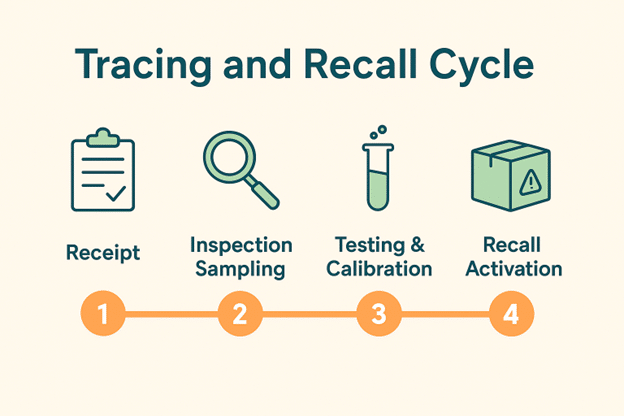
4) Traceability Cost: Minutes Matter, and Manual Systems Don’t Move Fast
When a customer asks “Which lots were affected?” the clock starts.
If you cannot answer quickly and confidently:
-
you widen the scope (more product impacted)
-
you extend holds (more lost sales)
-
you increase recall costs
-
you damage customer trust
Traceability isn’t just about having records. It’s about connecting them—ingredients, lots, processing steps, checks, deviations, corrective actions, shipping.
Manual records are usually fragmented across:
-
receiving logs
-
production sheets
-
CCP logs
-
sanitation checks
-
maintenance notes
-
shipping paperwork
In a crisis, you’re not “tracking product.” You’re chasing paper.
This is where Food traceability software becomes strategic, not optional.
5) Risk Cost: Manual Records Increase the Probability of Serious Events
Risk isn’t only “will something happen.” It’s “how likely and how severe.”
Manual systems increase both:
-
Higher likelihood of missed checks and delayed detection
-
Higher severity when you can’t prove control, can’t retrieve evidence, or can’t isolate product fast
Even if you never have a major recall, the expected value of risk is real. Regulators, customers, and certification bodies are moving toward stronger verification, data integrity, and rapid traceability expectations. Manual systems struggle under that pressure.
6) Data Integrity Cost: Paper Can’t Prove Itself
Paper doesn’t prove:
-
when it was filled
-
who filled it
-
whether it was edited
-
whether it was copied
-
whether it was accurate at the time
That matters more every year.
If a deviation occurs, you need to show:
-
actual monitoring happened
-
at the correct frequency
-
by trained personnel
-
with documented corrective actions
-
with verification
Paper can show a signature. It cannot show truth.
This is where food safety software becomes a credibility engine: timestamps, required fields, workflows, alerts, versioning, and traceability across events.
The Strategic Cost: Manual Records Hold Back Growth
Manual recordkeeping doesn’t just increase cost; it caps performance.
It slows down:
-
onboarding new plants and lines
-
training new supervisors
-
standardizing across sites
-
implementing continuous improvement
-
passing customer audits faster
-
entering new markets with stricter expectations
For C-level leaders, this is the key point:
Manual records create a scaling ceiling.
You can grow revenue, but your quality overhead grows faster. Eventually, you pay for it in churn, audit fatigue, and risk exposure.
Step-by-Step Approach to Move Away From Manual Records (Without Breaking Everything)
You don’t fix this by “going paperless” overnight. You fix it by targeting high-impact points and building momentum.
Step 1: Identify Your “Critical Control Evidence”
Start with the records that matter most to:
-
regulatory compliance
-
customer audits
-
certifications (GFSI schemes, HACCP, etc.)
-
risk reduction
Typical top candidates:
-
CCP monitoring logs
-
allergen control checks
-
sanitation pre-op verification
-
metal detector checks
-
cooler/freezer temperature logs
-
corrective action records
Deliverable: a list of 10–20 record types that represent your “proof of control.”
Step 2: Map the Current Workflow (Who, When, Where, How)
For each record type, answer:
-
Who fills it?
-
How often?
-
Where is it filled?
-
Who reviews it?
-
Where is it stored?
-
What happens if it’s out of spec?
-
How long does retrieval take?
Be honest. If the real workflow is “fill later when things calm down,” document that.
Deliverable: a simple process map and a pain-point list (missing entries, late fills, no alerts, etc.).
Step 3: Quantify the Waste (So You Can Justify Change)
Pick 3 metrics:
-
Minutes per shift spent on recordkeeping + follow-up
-
Audit prep hours per audit (internal + external)
-
Deviation handling time (from discovery to documented closure)
Then calculate annual cost. Don’t overcomplicate it. A rough number that leadership believes is better than a perfect number nobody uses.
Deliverable: a one-page business case.
Step 4: Digitize the Highest ROI Records First
Don’t start with everything. Start where digital wins are immediate:
-
high frequency
-
high audit value
-
high risk
-
lots of missing data
-
lots of corrective actions
Example rollout sequence:
-
Temperature monitoring logs (coolers/freezers)
-
Sanitation pre-op checks
-
Metal detector checks
-
Corrective actions + CAPA
-
Allergen changeover verification
-
Supplier approvals + COAs
Deliverable: a phased rollout plan that gives quick wins.
Step 5: Build “Rules” Into the System (Stop Relying on Memory)
This is where digital becomes better than paper.
Rules include:
-
required fields (no blank logs)
-
time windows (no backfilling without justification)
-
out-of-spec triggers (automatic corrective action workflow)
-
alerts to supervisors
-
escalation if not closed
-
proof of review (sign-off workflow)
Example:
If a cooler temperature is above the limit, the system automatically requires:
-
corrective action entry
-
product disposition decision
-
verification step
-
supervisor sign-off
On paper, that only happens if someone remembers and has time.
Step 6: Train for Behavior, Not for “Buttons”
Training fails when it’s only “click here.”
Train like this:
-
why the record exists (risk)
-
what “good data” looks like
-
what happens when out of spec
-
how supervisors review
-
what auditors will ask for
Deliverable: 30–60 minute role-based training, plus quick guides.
Step 7: Validate and Expand
After 30–60 days, review:
-
completion rates
-
number of deviations caught faster
-
time saved in review and retrieval
-
audit readiness improvements
Then expand to the next set of records.
Practical Examples: Manual vs Digital Outcomes
Example 1: Cooler Temperature Log
Manual:
Operator checks temp, writes it down. If out of spec, maybe it’s handled, maybe it’s not. QA finds it later during review—if the sheet wasn’t missed.
Digital:
Operator logs temp. If out of spec:
-
the system alerts supervisor
-
requires corrective action
-
documents product hold/disposition
-
timestamps everything
-
creates a clean audit trail
Result: less product risk and faster containment.
Example 2: Metal Detector Checks
Manual:
Checks recorded, but sometimes missing piece sizes, missing frequency, or unclear handwriting. If a failure happens, proving corrective action and recheck sequence is painful.
Digital:
The checklist requires ferrous / non-ferrous / stainless sizes, forces the correct frequency, and creates automatic deviation workflows.
Result: stronger control proof, less audit exposure.
Example 3: Sanitation Pre-Op Verification
Manual:
A “pass” checkbox can hide variability. Photos and notes are scattered. Trends aren’t visible.
Digital:
Structured criteria, photo capture, escalations for repeated failures, and trend insights across areas and shifts.
Result: better sanitation effectiveness and fewer surprises.
Where to Start If You’re a C-Level Executive
If you lead the business, here’s the blunt truth: manual records are not “low cost.” They are unmeasured cost.
Your best move is to ask three questions:
-
How many hours per month do we spend on audit prep and record retrieval?
-
How often do we discover missing or questionable records during review?
-
In a traceability event, how fast can we isolate affected product with confidence?
If the answers aren’t sharp, you have operational debt.
Ready to See What This Looks Like in Practice?
If you want to modernize your records, reduce risk, and make audits easier, the fastest way is to see a real workflow in action with food safety software designed for day-to-day execution—not just documentation.
Book a demo here: https://normex.ca/demo