Why 2026 Should Be the Year You Digitize Your Food Safety Program
Food businesses don’t usually lose sleep because they want to. They lose sleep because they’re one recall, one missed CCP record, one supplier surprise, or one audit finding away from a week (or a quarter) of chaos. And if we’re being honest, most of that stress isn’t caused by a lack of food safety intent—it’s caused by a system that still runs like it’s 2006: paper binders, spreadsheets, shared drives, manual sign-offs, scattered training records, and “tribal knowledge” living inside one person’s head.
2026 should be the year you stop managing risk with duct tape.
Digitizing your food safety program isn’t a “nice-to-have” anymore. It’s the simplest, most direct way to reduce risk, increase audit readiness, protect your brand, and free up your quality team to do real prevention work instead of spending their days chasing signatures and rebuilding records.
This article breaks down why digitization matters now, what changes when you do it, and how to implement it step-by-step—without derailing operations.
The real cost of staying manual
Manual systems feel “cheap” because you don’t see an invoice for paper. But you pay every day in hidden costs:
1) You spend labor on the wrong things
Quality professionals should be analyzing trends, preventing deviations, improving controls, strengthening suppliers, and building a culture. Instead, in manual environments, they spend time on:
-
Collecting and correcting paperwork
-
Chasing missing logs
-
Reformatting spreadsheets
-
Rebuilding evidence for audits
-
Manually compiling monthly KPI reports
That’s not food safety leadership. That’s administrative survival.
2) You accept unnecessary risk—quietly
Manual recordkeeping increases the chance of:
-
Incomplete logs
-
Backdating
-
Illegible entries
-
Missed verifications
-
Lost records
-
Inconsistent forms across shifts and sites
Even good teams make mistakes when the system is built for mistakes.
3) Traceability becomes slower than your crisis timeline
When something goes wrong, speed matters. If you can’t answer “what lots went where, from which supplier, and which customers received them?” fast, your recall scope gets larger, more expensive, and more damaging than it needed to be.
That’s why modern programs increasingly pair Food safety controls with Food traceability software—because “safe” isn’t only about process control; it’s also about fast containment when reality hits.
4) Audits become performance theater
Manual systems often lead to audit prep sprints:
-
Printing
-
Sorting
-
Cross-checking
-
Filling gaps
-
Explaining inconsistencies
It works—until it doesn’t. A digital program turns audit readiness into a steady state, not a last-minute scramble.
Why 2026 is the tipping point
A lot of companies meant to digitize in 2023, 2024, 2025… and didn’t. So why 2026?
Expectations are rising, fast
Customers, retailers, foodservice groups, and global partners are tightening requirements around:
-
Documentation integrity
-
Traceability speed
-
Supplier visibility
-
Proof of training and competency
-
Preventive controls, not reactive fixes
Whether you’re under CFIA, FDA, GFSI schemes, or customer standards, the direction is the same: more evidence, faster access, fewer excuses.
Complexity is increasing
More SKUs, more co-manufacturing, more allergens, more imported ingredients, more supplier variability, more turnover. Manual programs don’t scale well under complexity. Digital systems do.
You can no longer afford single points of failure
If one key person leaving would cripple your documentation system, your program isn’t resilient. Digitization forces standardization and preserves knowledge.
What “digitizing food safety” actually means
Digitizing doesn’t mean “we scan paperwork into PDFs.” That’s just digital clutter.
Real digitization means:
-
Standardized digital forms and workflows
-
Role-based permissions and approvals
-
Automated reminders and escalation
-
Time-stamped records and audit trails
-
Data capture that turns into analytics
-
Centralized storage with quick retrieval
-
Integration with sensors (where it makes sense)
-
Traceability and supplier documentation management
In other words: a real system, not a digital filing cabinet.
This is where food safety software changes the game: it turns your program from documentation-heavy to control-focused, from reactive to proactive, and from manual effort to automated discipline.
The business case that speaks to C-level
Food safety leaders often have to “sell” digitization internally. Here’s how to frame it in leadership language:
Reduce risk exposure
-
Lower probability of non-conformities and enforcement action
-
Smaller recall scope through faster traceability
-
Better control over allergens and sanitation verification
-
Stronger supplier oversight
Improve operational efficiency
-
Less time spent on admin and reconstruction
-
Faster investigations (deviations, complaints, failures)
-
Better shift-to-shift consistency
-
Reduced downtime caused by missing records
Protect revenue and customer relationships
-
Better audit outcomes
-
Faster customer document responses
-
Stronger trust and credibility
-
Less “we’ll get back to you” moments
Build scalability
A digital program supports multi-site operations, growth, acquisitions, new product lines, and new markets without turning quality into a bottleneck.
Step-by-step: How to digitize in 2026 without breaking your operation
Most digitization failures come from trying to do everything at once. Here’s a practical approach that works.
Step 1: Map your current program and pain points (1–2 weeks)
Don’t start with software. Start with clarity.
Create a simple map:
-
CCPs / OPRPs (or key control points)
-
Monitoring records (temps, metal detector checks, sanitizer checks, etc.)
-
Pre-op / sanitation inspections
-
Receiving checks and supplier COAs
-
Corrective action process
-
Training records
-
Internal audits
-
Complaint handling
-
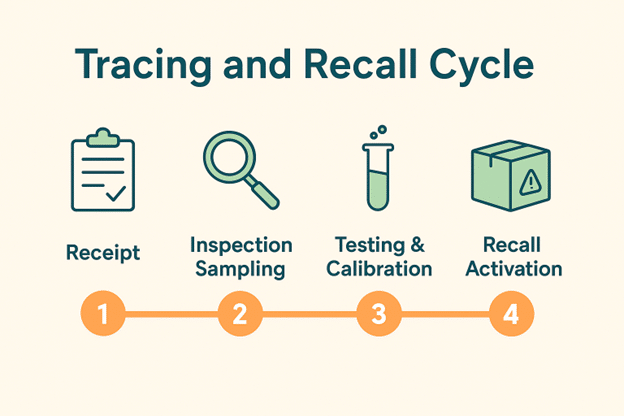
Traceability and recall process
-
Document control (SOPs, forms, revisions)
Then label the top friction points:
-
Which records are most often incomplete?
-
Where do you lose time?
-
Which audit sections create panic?
-
Where do you rely on one person?
This becomes your digitization plan.
Example:
If 30% of your cooling logs have gaps, digitize cooling logs early. That’s immediate risk reduction.
Step 2: Digitize the “high-frequency, high-risk” records first (Weeks 2–6)
This is the quickest win.
Start with records that are:
-
Done daily or multiple times per day
-
Tied to safety outcomes
-
Frequently audited
-
Frequently missed or inconsistent
Typical first set:
-
CCP monitoring logs
-
Pre-op and sanitation checks
-
Receiving inspections
-
Temperature checks (coolers/freezers/cook/chill)
-
Corrective action workflow (digital deviation tickets)
Example:
A digital temperature check can require:
-
A valid range
-
A comment if out-of-range
-
A corrective action selection
-
A manager sign-off
-
Automatic escalation if unresolved
Paper can’t enforce discipline like that.
Step 3: Standardize corrective actions and investigations (Weeks 4–8)
This step is where your program becomes more mature—fast.
Build one consistent workflow:
-
Deviation detected
-
Immediate containment action
-
Product disposition decision
-
Root cause analysis (simple, not academic)
-
Preventive action assignment
-
Verification of effectiveness
-
Closure approval
Example:
If a metal detector fails a check:
-
System forces hold of affected product lots
-
Requires recheck and rework documentation
-
Captures who did what, when, and why
-
Stores evidence for audit and customer requests
That level of control is hard to do reliably with manual methods.
Step 4: Bring document control and training into the same system (Weeks 6–12)
Most companies underestimate how much risk sits in training and document control.
Digitize:
-
SOPs with version control
-
Acknowledgements (who read what, when)
-
Training modules and competency verification
-
Automatic retraining reminders
-
Role-based assignment (e.g., sanitation team vs. production leads)
Example:
If an allergen change is made to a SOP:
-
The system publishes the new version
-
Assigns training to impacted roles
-
Blocks sign-off until complete
-
Preserves evidence for audits and incident defense
This is how you reduce “human drift.”
Step 5: Add traceability and supplier documentation (Weeks 10–16)
If you only digitize internal checks but traceability is still manual, you’re leaving a major gap.
Digitize:
-
Supplier approvals
-
COA management
-
Lot/ingredient receiving and linkage
-
Finished product lot creation
-
One-step forward / one-step back reporting
-
Recall simulation reporting
This is where Food traceability software becomes a strategic advantage: it shrinks your recall window and improves your containment precision.
Example:
A customer complains about an off-flavor in a lot:
-
In a strong traceability system, you quickly link the finished lot to raw lots, suppliers, production date, line, shift, and distribution.
-
You narrow scope to what’s truly affected instead of widening to “everything produced that week.”
Step 6: Use your data to move from compliance to prevention (Ongoing)
Once you’re collecting structured data, you can finally do what quality teams are supposed to do:
-
Trend recurring deviations by line/shift/product
-
Spot sanitation failures before they become contamination
-
Identify high-risk suppliers
-
Reduce rework and product holds
-
Predict where failures will happen next
Digitization isn’t the end goal. A safer, more consistent operation is.
Common objections (and the honest answers)
“We’re too busy.”
You’ll stay busy forever if you keep a system that generates busywork. Digitize the high-frequency records first and you’ll buy back time quickly.
“Our team won’t adopt it.”
Adoption fails when:
-
The workflow is poorly designed
-
The rollout is too big
-
The tools don’t match the reality of the floor
Start small, build wins, train properly, and involve supervisors early.
“It’s expensive.”
Manual risk is expensive. Recalls, audit failures, customer chargebacks, lost contracts, and constant admin hours cost more than software—just less visibly.
What a successful 2026 digitization looks like
By mid-2026, a successful program should look like this:
-
Daily monitoring is consistent and complete
-
Deviations trigger workflows automatically
-
Audit evidence is searchable in seconds
-
Training and SOP control are always current
-
Traceability reports are fast and defensible
-
Your quality team spends more time improving and less time chasing
That’s what “digitized” actually means.
Want to see what this looks like in your operation?
If you’re serious about making 2026 the year you stop running food safety on spreadsheets and paper, book a demo here: https://normex.ca/demo
You’ll get a clear view of what a modern, digitized food safety program looks like—and how quickly it can reduce risk, improve execution, and make audits feel boring again (in the best way).